 Aimatra
electrochemistry
AimatraLab Pourbaix Studio
Offline potential–pH diagrams for single-element E–H–O systems, with sourced data, adjustable conditions, Chinese/English UI and PNG/SVG/CSV/JSON export. Includes 73 reference subsets; computation requires a machine-bound license.
New calculations require a valid machine-bound license for this product. Copy the machine code from Authorization, obtain a signed license through the official contact channel, then paste the signed license code and activate.
Overview
Build potential–pH diagrams offline for single-element aqueous systems.
73 reference subsets · Adjustable conditions · Traceable sources · PNG / SVG / CSV / JSON export
New to Pourbaix diagrams?
The horizontal axis is pH; the vertical axis is potential against the stated reference. Colors show predominance among the included species; dashed lines mark water-stability boundaries. A solid region alone does not prove a protective film.
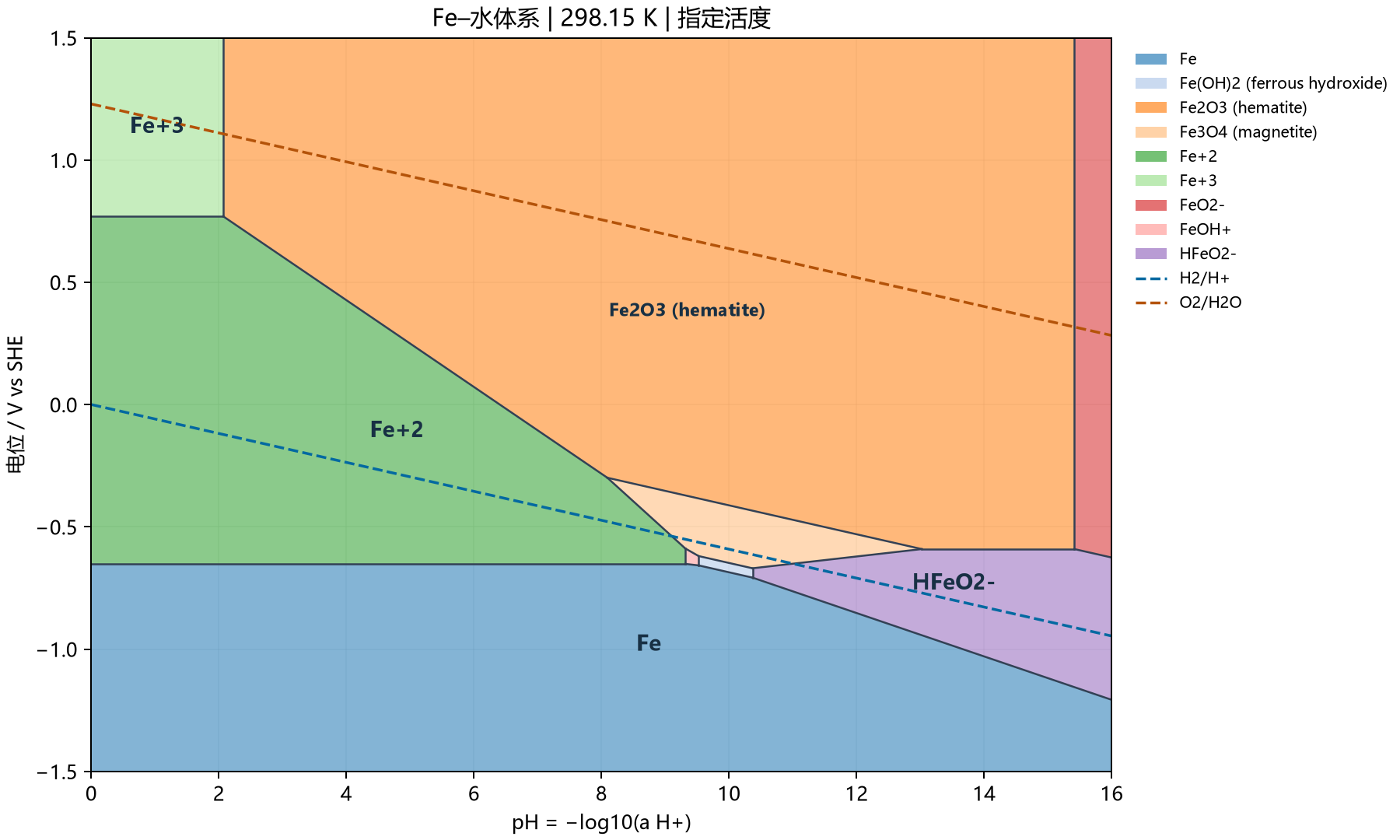
Fe–water: thermodynamic predominance of metal, dissolved ions and oxide phases.
298.15 K, 1 bar; pH 0–16; -1.5 to 1.5 V vs SHE; imposed concentration 1e-6 mol/kg per dissolved species, gamma=1.
These thermodynamic examples are actual software calculation exports, not experimental measurements. See each figure for its data and conditions.
Compare four independent systems
Four independent single-element systems, not a coupled multimetal calculation. Al extends to -2.5 V; the other three extend to -1.5 V. Read each original axis.
Fe–water: thermodynamic predominance of metal, dissolved ions and oxide phases.
298.15 K, 1 bar; pH 0–16; -1.5 to 1.5 V vs SHE; imposed concentration 1e-6 mol/kg per dissolved species, gamma=1.
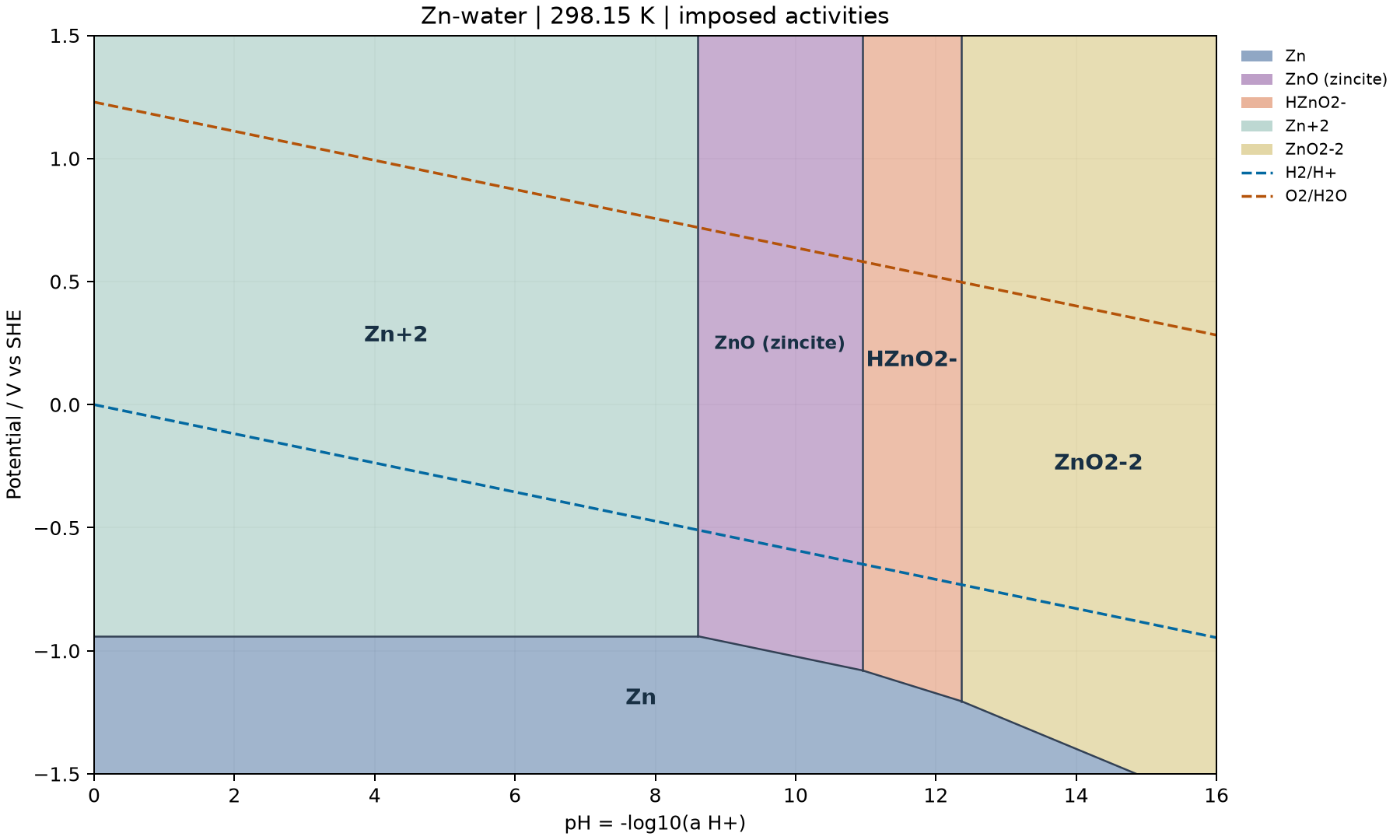
Zn–water: explore metal, ion and oxide predominance as pH changes within this model.
298.15 K, 1 bar; pH 0–16; -1.5 to 1.5 V vs SHE; imposed concentration 1e-6 mol/kg per dissolved species, gamma=1.
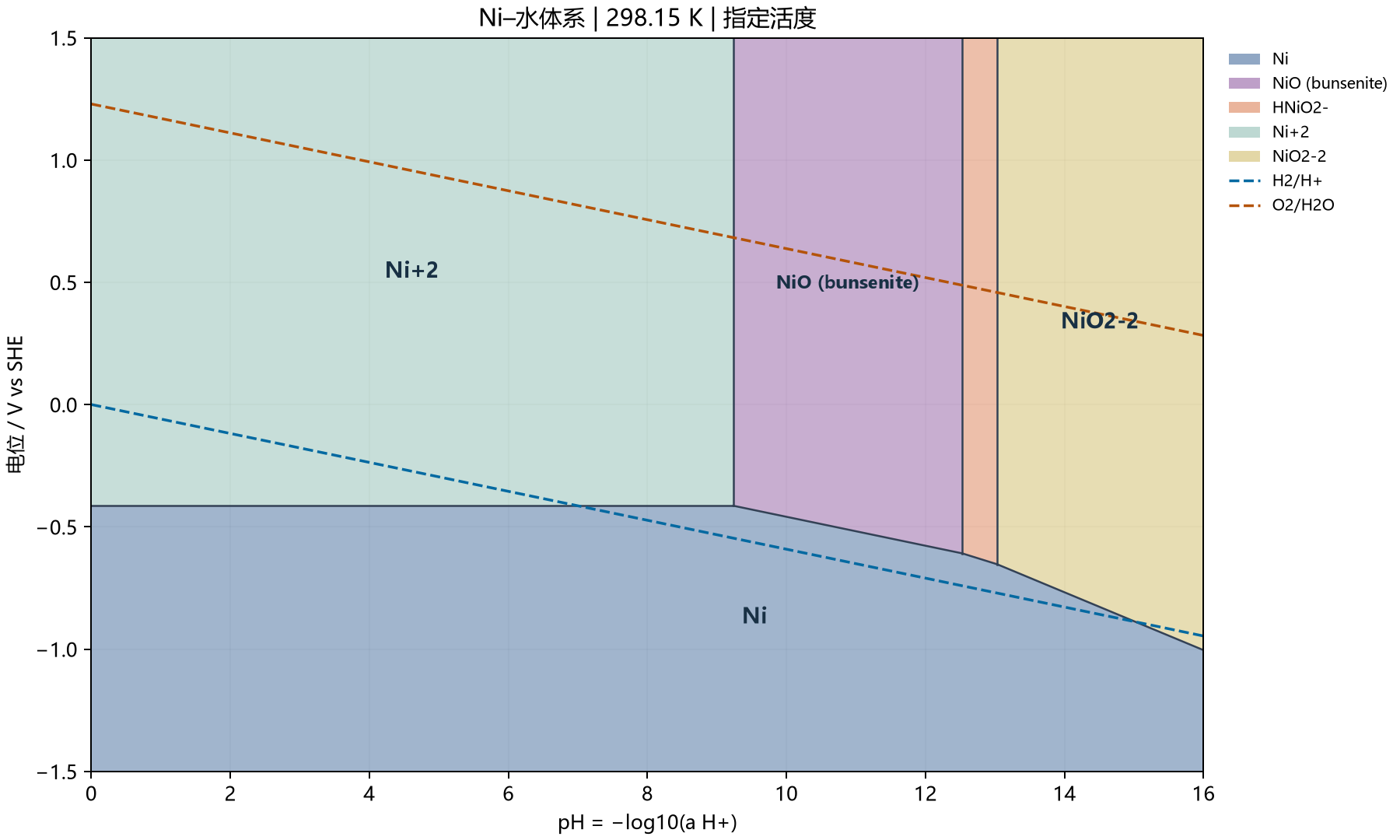
Ni–water: compare thermodynamic regions for Ni metal, Ni2+ and oxide species.
298.15 K, 1 bar; pH 0–16; -1.5 to 1.5 V vs SHE; imposed concentration 1e-6 mol/kg per dissolved species, gamma=1.
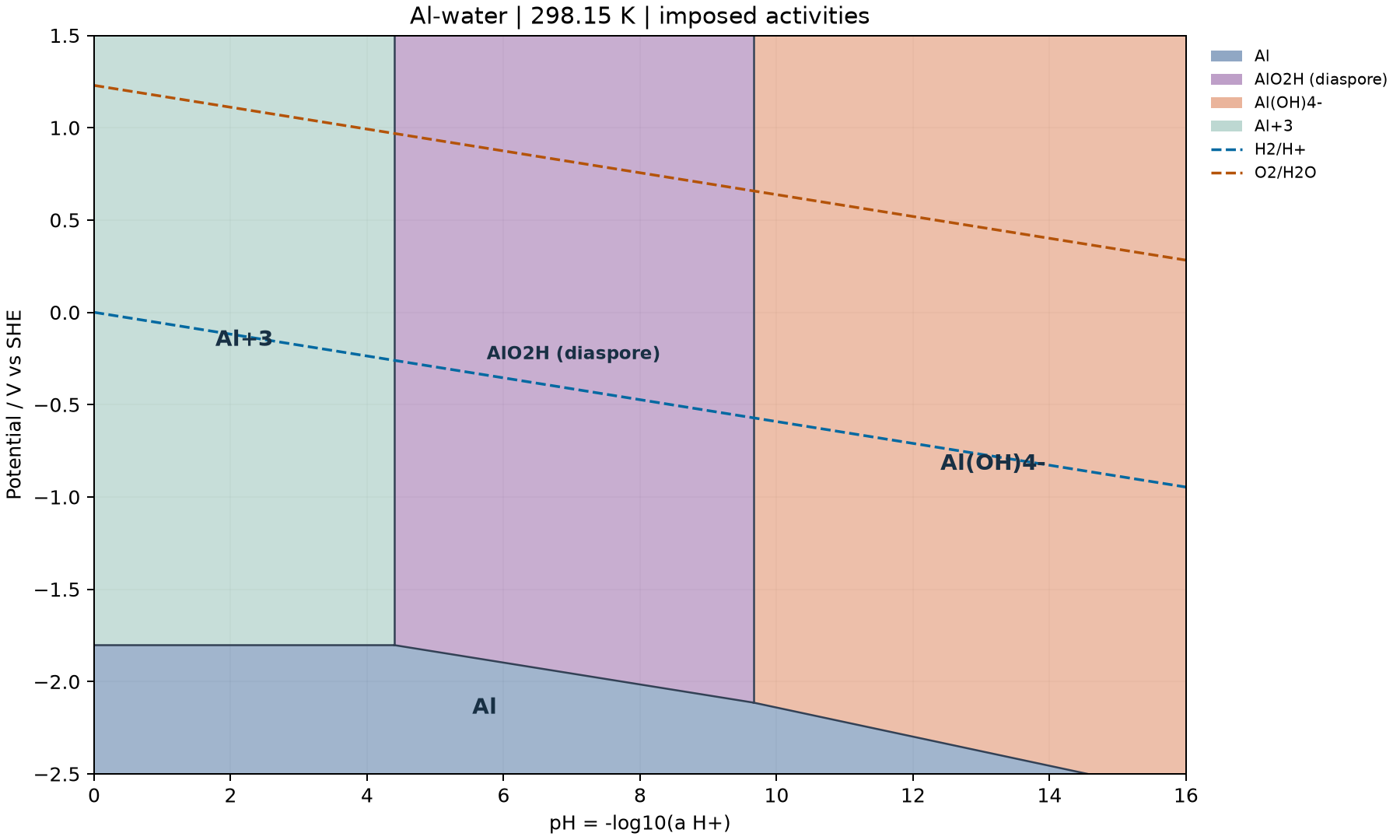
Al–water: inspect the included dissolved and solid species under acidic and alkaline conditions.
298.15 K, 1 bar; pH 0–16; -2.5 to 1.5 V vs SHE; imposed concentration 1e-6 mol/kg per dissolved species, gamma=1.
Historical Cu benchmark
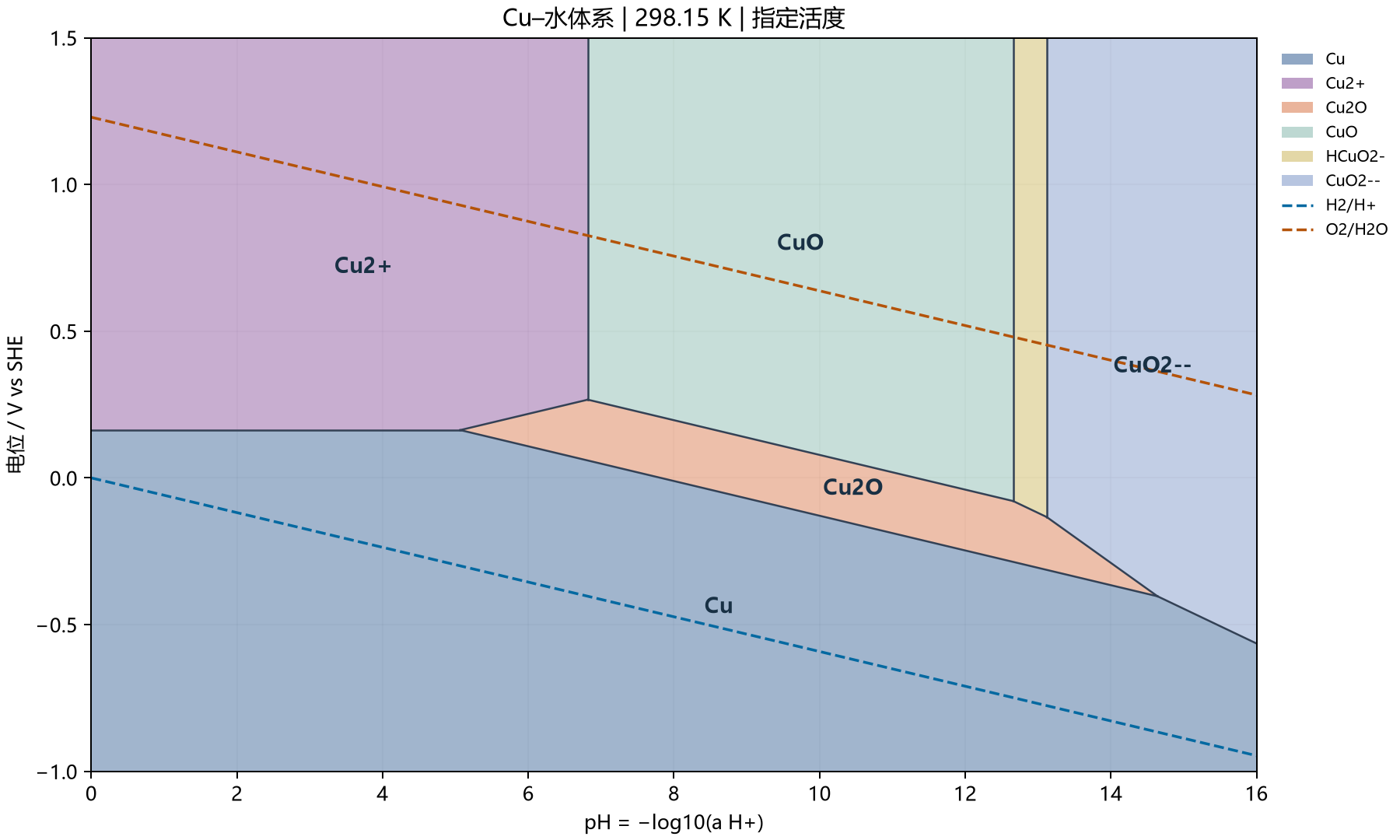
Historical Cu–water benchmark: model regions for Cu, Cu2+, Cu2O and CuO, retaining the mol/L convention.
298.15 K, 1 bar; pH 0–16; -1 to 1.5 V vs SHE; imposed concentration 1e-6 mol/L per dissolved species, gamma=1.
Data & model scope
The 73 single-element E–H–O reference subsets contain 473 species. The coverage table shows available, insufficient or missing data for 118 elements; this is not exhaustive element or phase coverage. Omitted species can change the regions.
The current model uses imposed individual activities. It does not solve total-concentration mass balance, coupled multimetal or complex-ligand equilibrium, corrosion rate or passive-film protection. Use data and experimental judgment appropriate to your system.
New reference subsets use a pinned CHNOSZ/OBIGT source at 298.15 K and 1 bar: missing values are not guessed, with no temperature extrapolation. The historical Cu benchmark retains its literature provenance and mol/L convention; the other examples use mol/kg without silent conversion.
Use & activation FAQ
Is internet access or Python required?
Calculations and license verification run offline; customers do not need Python or an API key. Downloads and seller contact use their respective channels.
Can I start new calculations immediately after download?
New calculations require a valid machine-bound license for this product. Trial, fixed-term or perpetual access is defined by the issued entitlement. Save and reopen projects; export results with data, conditions, sources and assumptions.
Features
- Select from 73 single-element E–H–O reference subsets with 473 species; inspect availability status for 118 elements, without assuming full coverage.
- Adjust pH, potential, individual dissolved-species concentrations and activity coefficients; choose participating species and SHE/RHE references.
- Track thermodynamic data sources, inputs and assumptions; save and reopen projects. Reference subsets use 298.15 K and 1 bar.
- Export PNG/SVG figures and CSV/JSON data with source and assumption reports; switch Chinese/English in one offline executable without installing Python.
- Imposed species activities in single-element systems: no total-mass balance, multimetal coupling, complex-ligand equilibrium or corrosion-rate prediction.
Version history
Extract the entire archive and run AimatraLab-Pourbaix.exe; retain the adjacent _internal folder.
You can switch Chinese/English in the interface. Calculations and license verification run offline without a separate Python installation.
New calculations require a machine-bound license for this product. Copy the machine request from Authorization, obtain a code through the official contact channel, and paste it to activate. Trial, fixed-term or perpetual access is defined by the issued entitlement.
Website sign-in to download and application activation are separate. Activation contact: hello@aimatralab.com
Package & checksum
This filename, size and checksum identify the main-download customer package.
AimatraLab-Pourbaix-1.2.0-licensed-windows-x64.zip
70791204 bytes
SHA-256: 794844bc16f2811782346b1567434071785156fd3ed0a3fe649a6ed465b5f0ef
Baidu Netdisk access code: kmvf. The expiry shown by Baidu applies.
Updates & usage guides
Follow our WeChat and Xiaohongshu accounts for AimatraLab Pourbaix Studio version updates, tutorials and case studies.
WeChat Official Account
迷之炼金术士
WeChat ID:wband2046
Xiaohongshu
向天歌
Xiaohongshu ID:231054605