 Aimatra
科学人物 05 / PEOPLE IN SCIENCE 05
两道缝为什么会出现明暗条纹?——托马斯·杨与光的叠加
Why Do Two Slits Produce Bright and Dark Fringes? — Thomas Young and the Superposition of Light
从一条窄卡片的影子,读懂光波怎样相遇Reading how light waves meet in the shadow of a narrow card
再添一束光,为什么反而变暗
Why can adding light make a place darker?
两支手电照向同一面墙,我们通常期待重叠处更亮。如果添上一束光,某些地方反而变暗,直觉便遇到了麻烦。关键不只是来了多少光,还在于两束光的振动怎样配合;普通手电缺少稳定的配合,通常看不见固定条纹。[3]
Aim two torches at the same wall and we normally expect their overlapping beams to make it brighter. If adding light instead darkens some places, intuition runs into trouble. What matters is how the oscillations of the two beams relate, as well as how much light arrives. Ordinary torches lack a stable relationship and generally produce no stationary fringes. [3]
1801年11月12日,托马斯·杨在英国皇家学会宣读《论光与颜色的理论》,论文于1802年刊出。他没有把自己写成推倒一切的英雄,开篇反而称赞牛顿的光学观察,想用简明的共同原理,重新连接那些看似分散的事实。[1]
On 12 November 1801, Thomas Young read On the Theory of Light and Colours to the Royal Society; the paper appeared in 1802. He did not present himself as a hero overturning everything. He praised Newton's optical observations near the outset and sought simple common principles that could connect apparently disparate facts. [1]
在论文的第八个命题中,他提出,两列波相遇时,合成运动可以加强,也可以削弱。他把研究声音时熟悉的叠加思路带进光学:同一套规则,或许既能说明亮处,也能说明暗处。困难是怎样让光把这种配合显露出来。[1]
In his eighth proposition, Young argued that when two trains of waves meet, their combined motion can strengthen or weaken. He brought into optics a principle of superposition familiar from his work on sound: one rule might account for darkness as well as brightness. The challenge was to make light reveal this relationship. [1]
证据藏在卡片的影子里
Evidence in a card's shadow
另一次讲演把证据推到眼前:杨于1803年11月24日宣读《有关物理光学的实验与计算》,次年发表。他在开头强调,接下来描述的实验只需身边的器材,有阳光时便容易重复;这给读者留下了亲手核对的入口。[2]
A later lecture brought the evidence into view. Young read Experiments and Calculations Relative to Physical Optics on 24 November 1803, and it appeared the following year. He began by stressing that the experiments required readily available apparatus and could be repeated easily when the sun shone, inviting readers to check the evidence themselves. [2]
他用窗板外的小镜子反射阳光,让光近乎水平穿过覆盖窗孔的厚纸针孔,送过桌面。他把一条窄卡片放进光束,观察墙面或纸屏上的影子。出人意料的是,影子内部也出现平行的明暗纹,中间仍然明亮。[2]
A small mirror outside the shutter reflected sunlight almost horizontally through a needle hole in thick paper covering the shutter opening, directing it across a table. Young placed a narrow strip of card in the beam and examined its shadow on a wall or paper screen. Parallel fringes appeared within the shadow itself, with a bright centre. [2]
杨又插入一块小屏,挡住从卡片一侧进入影区的光,内部那组条纹随即消失。这个动作比单看条纹更有说服力:它检验了两侧光的共同作用。不能因此说一侧光毫无结构;这里消失的是原先影区中的干涉纹。[2]
Young then inserted a small screen to intercept light entering the shadow from one side of the card. The internal fringes disappeared. This intervention was more telling than the pattern alone: it tested the joint contribution of light from both sides. It does not establish that one-sided light has no structure; the disappearing pattern was the interference inside the shadow. [2]
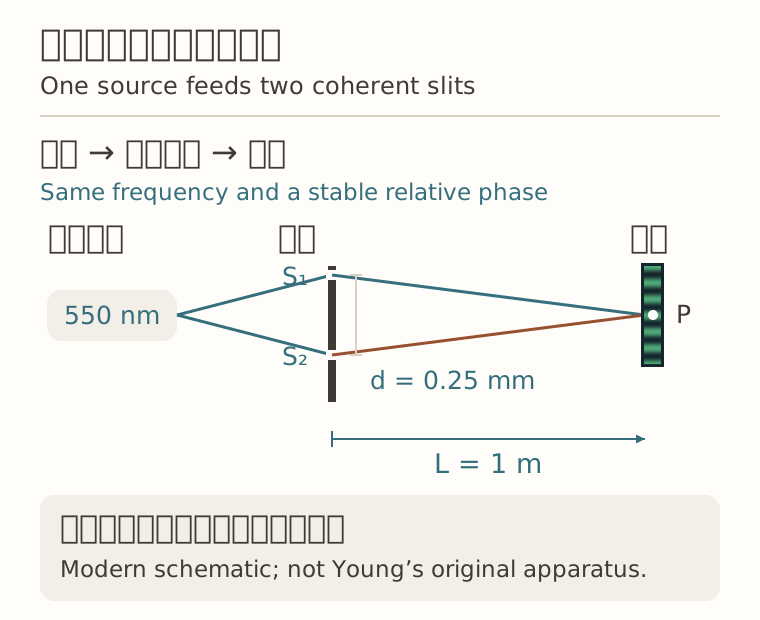
因此,“杨的双缝实验”不宜被压缩成1801年一次与现代图画完全相同的演示。下面采用两道狭缝和远处光屏,是为了把两路光及其路程差分清楚的现代教学模型;它与窄卡片实验共享叠加的核心问题。[1,2,3,4]
Young's double-slit experiment should therefore not be compressed into a single 1801 demonstration identical to a modern diagram. We will use two narrow slits and a distant screen as a modern teaching model that separates the two contributions and their path difference. It shares the card experiment's central question about superposition. [1,2,3,4]
先加振动,再算亮度
Add the oscillations before calculating brightness
先选近似单色的光,让同一光源对称照亮两缝,使两路频率相同、相位差稳定;再取相同偏振方向。这里的“相干”指振动保持确定的相位关系,不要求它们到达光屏每一点时都同相。[3]
Choose approximately monochromatic light and illuminate both slits symmetrically from one source, giving the contributions the same frequency and a stable phase difference. Take the same polarization direction too. Coherence means a definite phase relationship; it does not require the waves to arrive in phase at every point on the screen. [3]
用现代电磁波语言,某点的电场是E=E₁+E₂,正负表示电场方向。探测器读出的光强与合成电场平方的时间平均有关。因此不能先把两路各自的亮度相加;必须先让有方向的振动相加,再取平方。[3,5]
In modern electromagnetic language, the electric field at a point is E = E₁ + E₂, with signs indicating field direction. Measured intensity depends on the time average of the square of the combined field. We must therefore add the directed oscillations before squaring, rather than first adding the intensities of the separate contributions. [3,5]
设每一路单独在该点产生的光强都是I₀。同相到达时振幅加倍,光强便是4I₀;相差半个周期时,等振幅的电场完全抵消,理想光强为零。两路光合起来的局部范围是零到4I₀,最亮处不是2I₀。[3,5]
Let each contribution alone produce intensity I₀ at the chosen point. Arrival in phase doubles the amplitude and gives 4I₀. A half-cycle offset cancels equal field amplitudes and gives an ideal zero. The local intensity can range from zero to 4I₀; its maximum is not 2I₀. [3,5]
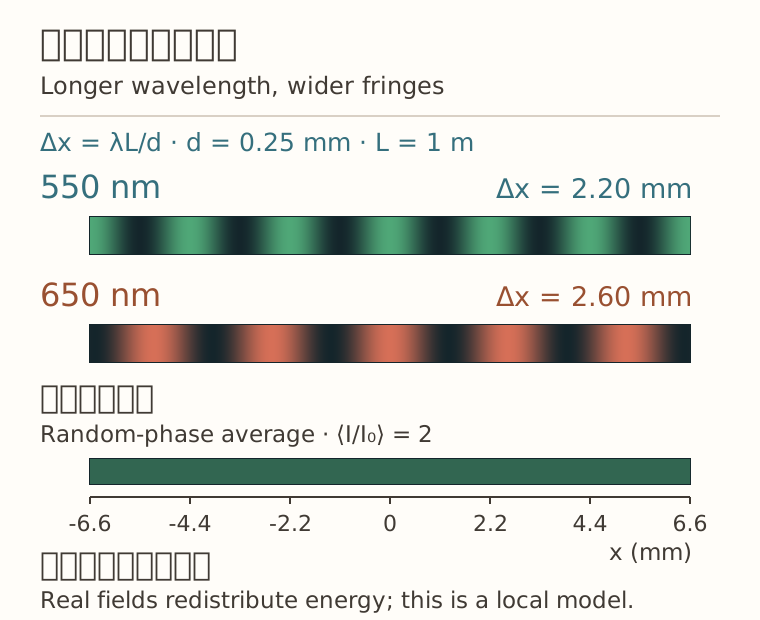
若相位差在探测时间内均匀随机变化,忽强忽弱的交叉项平均为零,读数才成为2I₀。稳定条纹要求相干,振幅相等才可能全暗。这里使用的是后来的波动表述与计算,不能把电场符号和现代公式原样归给杨。[1,3,5]
If the relative phase samples its cycle uniformly at random during detection, the fluctuating interference term averages to zero and the reading becomes 2I₀. Stable fringes require coherence, while complete darkness requires equal amplitudes. This is a later wave formulation and calculation; its electric-field notation and modern equations should not be attributed directly to Young. [1,3,5]
教学机制示意
Teaching schematic
五步看懂:先加振幅,再求强度Five steps: add amplitudes before intensities
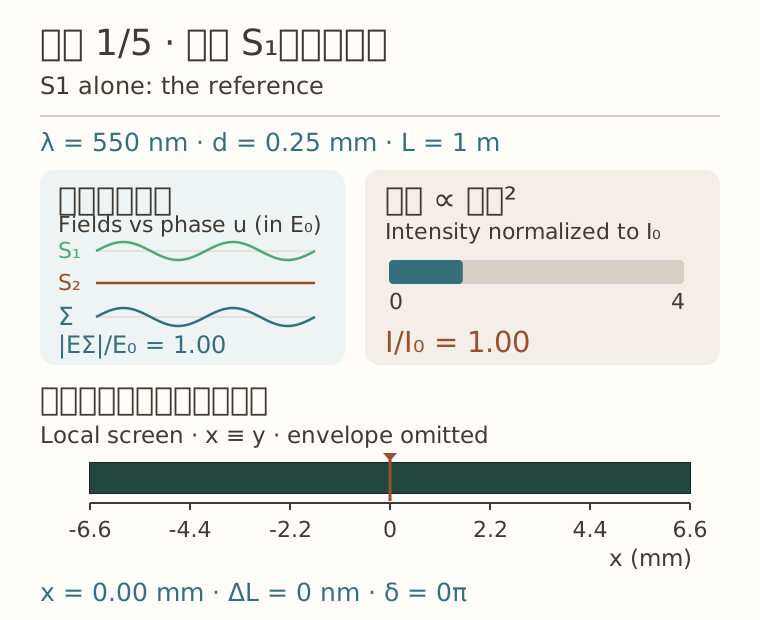
五步依次改变开缝条件、读数位置和相干条件;它们不是波传播的等时间间隔动画。屏幕横坐标图示为 x,模型公式写作 y,二者含义相同。以每缝单独的局部强度 I₀ = 1 为强度基准、对应电场振幅 E₀ 为电场基准;显示无量纲合振幅 |EΣ|/E₀,I/I₀ = |EΣ/E₀|²。
These five states change open slits, measurement location, and coherence conditions; they are not equal-time frames of wave propagation. Screen coordinate x in plots is y in the model formulas. Each slit alone defines local intensity I₀ = 1 and electric-field amplitude E₀. The displayed resultant amplitude |EΣ|/E₀ is dimensionless, with I/I₀ = |EΣ/E₀|².
只开 S₁:单缝基准S1 alone: the reference
1 / 5只开 S₁,在中心 x = 0 mm 测量。把单缝在这块局部屏幕区域的强度定义为 I₀,其电场振幅为 E₀;归一化振幅 |E|/E₀ = 1,读数 I/I₀ = 1。这里省略单缝衍射包络,因此“单缝恒定”只属于本局部模型。
Open only S1 and measure at x = 0 mm. Define its intensity in this local patch as I₀ and its electric-field amplitude as E₀. The dimensionless amplitude |E|/E₀ = 1 gives I/I₀ = 1. The single-slit diffraction envelope is omitted, so the constant single-slit reading belongs only to this local model.
- 屏幕位置 x(即 y)Screen position x (same as y)
- 几何光程差 ΔLGeometric path difference ΔL
- 几何相位差 δGeometric phase difference δ
- 无量纲合振幅 |EΣ|/E₀Dimensionless resultant amplitude |EΣ|/E₀
- 归一化强度 I/I₀Normalized intensity I/I₀
- 相干条纹间距 ΔxCoherent fringe spacing Δx
模型边界Model boundary
模型边界:单色、同偏振、两缝等振幅,初始同相;近轴远屏局部模型,忽略有限狭缝衍射包络、有限光束形状与吸收。λ = 550 nm = 5.50×10⁻⁷ m,d = 0.25 mm = 2.50×10⁻⁴ m,L = 1 m;y 以 mm 输入,先乘 10⁻³ 转换为 m。ΔL ≈ dy/L,δ = 2πΔL/λ;S₁ 单独 I/I₀ = 1,相干双缝 I/I₀ = 2 + 2cosδ = 4cos²(δ/2),相对相位在探测平均期间均匀随机时 ⟨I/I₀⟩ = 2;平均强度不等于平均电场的平方。相邻亮纹间距 Δx = λL/d = 2.20 mm。L、d、λ 必须有限且为正;支持 |y|/L ≤ 0.01、d/(2L) ≤ 0.01 的保守近轴区域,拒绝无效输入和非有限派生读数。仅显示值舍入;极小浮点残差显示为 0。暗处不表示能量消失,真实完整干涉场重新分布能量;本无包络局部模型不用于计算有限光束总功率。
Model boundary: monochromatic light, identical polarization, equal slit amplitudes, and zero initial phase difference. This is a local paraxial distant-screen model, omitting finite-slit diffraction envelopes, finite beam shape, and absorption. λ = 550 nm = 5.50×10⁻⁷ m, d = 0.25 mm = 2.50×10⁻⁴ m, and L = 1 m. Input y in mm is multiplied by 10⁻³ to convert to m. ΔL ≈ dy/L and δ = 2πΔL/λ. S1 alone gives I/I₀ = 1; coherent slits give I/I₀ = 2 + 2cosδ = 4cos²(δ/2); relative phase uniformly randomized during detector averaging gives ⟨I/I₀⟩ = 2. Mean intensity is not the squared mean field. Adjacent-fringe spacing is Δx = λL/d = 2.20 mm. L, d, and λ must be positive and finite. The conservative supported domain is |y|/L ≤ 0.01 and d/(2L) ≤ 0.01; invalid inputs and non-finite derived readings are rejected. Only display values are rounded, with tiny floating-point residuals shown as zero. A physical full interference field redistributes energy; this envelope-free local model does not calculate finite-beam total power.
把路程差变成一把尺
Making a ruler from path difference
同相出发的两路光,到光屏某点走过的距离可能不同。多走整整一个波长λ,仍像两人合着节拍;多走半个波长,就错开半个周期。移动观察位置,改变的是路程差,所以明与暗会依次交替。[3,4]
Two contributions leaving in phase may travel different distances to a point on the screen. An extra full wavelength λ keeps them in step; an extra half wavelength puts them half a cycle apart. Moving across the screen changes this path difference, producing successive bright and dark fringes. [3,4]
两缝中心相距d,光屏距离为L;在L远大于d且观察角度很小时,距中央y处的路程差近似为ΔL≈dy/L。这个式子把细小的路程差放大成屏上可量的位置,近似条件也规定了这把尺能在哪里使用。[4]
Let the slit centres be separated by d and the screen be a distance L away. When L is much greater than d and the observation angle is small, the path difference at displacement y from the centre is approximately ΔL ≈ dy/L. This converts a tiny path difference into a measurable screen position, within the stated approximations. [4]
路程差为整数个波长时出现亮纹,为半整数个波长时出现暗纹。于是相邻亮纹间距Δy≈λL/d:拉远光屏,条纹展开;增大缝距,条纹变密。公式描述空间位置,不是说光在亮纹之间停止传播。[3,4]
Integer-wavelength path differences give bright fringes; half-integer differences give dark ones. Adjacent bright fringes are therefore separated by Δy ≈ λL/d. Moving the screen farther away spreads the pattern, while increasing slit separation packs it more closely. This equation locates fringes; it does not imply that light stops propagating between bright fringes. [3,4]
例如取λ=550纳米、d=0.25毫米、L=1米,算得亮纹间距约2.2毫米。保持其余条件,把波长换成600纳米,间距变为2.4毫米。这是教学计算,显示我们怎样由屏上的毫米间隔,反推肉眼分不出的波长。[4]
For a teaching example, take λ = 550 nm, d = 0.25 mm and L = 1 m. The bright-fringe spacing is about 2.2 mm. Changing the wavelength to 600 nm while holding the other quantities fixed gives 2.4 mm. Measurable millimetre intervals can thus reveal wavelengths far too small to distinguish by eye. [4]
暗纹没有吃掉能量
Dark fringes do not consume energy
暗处的能量去了哪里?在完整、无损的光学系统中,干涉改变能量的空间分布:有些位置减少,另一些位置增加。局部光强为零,并不等于能量被消灭;同样,某一点达到4I₀,也不能推出整张屏的总功率翻了四倍。[5]
Where has the energy at a dark fringe gone? In a complete lossless optical system, interference changes its spatial distribution: some places receive less and others more. Zero local intensity does not mean that energy has been destroyed. Nor does 4I₀ at one point imply four times the total power across the screen. [5]
真实狭缝还有宽度,各缝自身的衍射会给条纹罩上明暗变化的包络。前面的等振幅模型忽略了这个包络,只适合解释局部条纹;不能把它无限延伸后积分,冒充整个装置的能量账。模型越简洁,越要记得它省略了什么。[6]
Real slits have finite width. Diffraction from each slit gives the fringes a broader envelope of varying brightness. Our equal-amplitude model neglects that envelope and explains the local pattern; extending it without limit and integrating would not provide the energy account of the whole apparatus. A simple model requires attention to what it leaves out. [6]
再看杨挡住一侧光的动作:他没有只问“这里亮不亮”,而是追问“改变哪一部分,条纹就会消失”。一条卡片与一块小屏,让看似不合常理的暗纹成为可重复的证据。发现的力量,就藏在这个把解释交给实验检验的动作中。[2]
Return to Young's act of blocking light from one side. He asked which contribution could be changed to make the fringes disappear, moving beyond a judgment of brightness alone. A narrow card and a small screen turned seemingly puzzling darkness into repeatable evidence. The discovery gains its force from this act of putting an explanation to an experimental test. [2]
参考资料 / References
- Thomas Young · The Bakerian Lecture: On the Theory of Light and Colours · Philosophical Transactions 92 (1802), 12–481801年11月12日宣读、1802年发表;开篇对牛顿观察与统一原理的讨论,以及命题VIII的波动叠加。
- Thomas Young · The Bakerian Lecture: Experiments and Calculations Relative to Physical Optics · Philosophical Transactions 94 (1804), 1–161803年11月24日宣读、1804年发表;第1–3页的针孔阳光、窄卡片及遮挡一侧后影区条纹消失的原始实验记录。
- OpenStax · University Physics Volume 3 · 3.1 Young's Double-Slit Interference相干、同一光源、振幅叠加及整波长/半整数波长的路程差条件;历史装置与年代采用杨的原始论文核查,不照搬本节的简化历史叙述。
- OpenStax · University Physics Volume 3 · 3.2 Mathematics of Interference远屏与小角度近似、路程差、亮暗纹位置,以及由相邻亮纹公式推得的间距和本文教学算例。
- OpenStax · College Physics · 16.11 Energy in Waves: Intensity光强作为单位面积功率、振幅平方关系、相长时局部四倍光强及能量守恒;随机相位平均为2I₀由相干定义和振幅相加作现代推导。
- OpenStax · University Physics Volume 3 · 4.3 Double-Slit Diffraction有限缝宽时,双缝干涉条纹受单缝衍射包络调制;正文明确等振幅教学模型的边界。