 Aimatra
科学人物 09 / PEOPLE IN SCIENCE 09
把时钟拨快,能量会改变吗?——诺特与守恒的来处
Does Moving the Clock Change Energy? — Noether and the Roots of Conservation
从时间平移到弹簧的能量账本,看清连续对称性究竟保住了什么From time translation to a spring's energy ledger, see what continuous symmetry preserves
同一段运动,换一个时钟原点
The same motion with a different clock origin
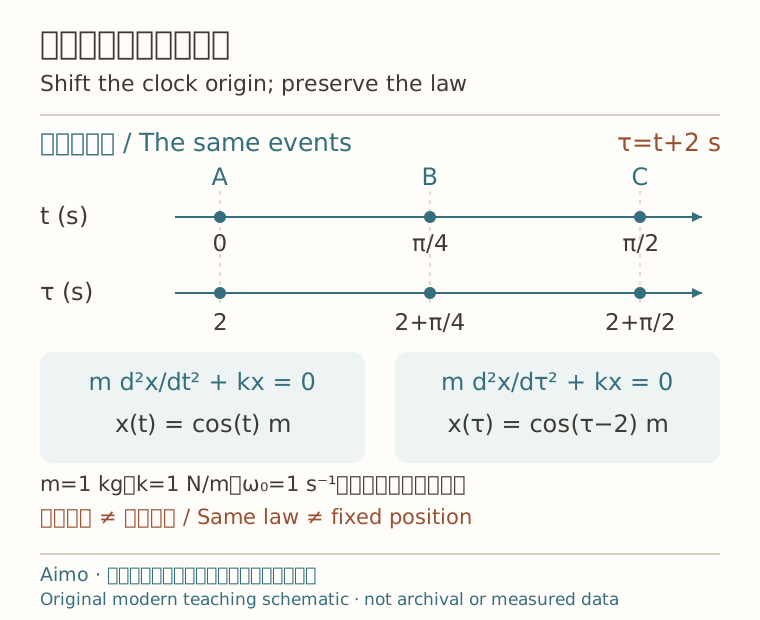
想象一块沿直线往复的弹簧滑块。你把释放时刻记为零秒,朋友记为十秒。若弹簧和环境不随时刻改变,两套记录应服从同样的规律。自然不偏爱哪一页日历,这是时间平移对称性的入口。[4]
Imagine a spring-mounted block moving back and forth along a line. You label its release zero seconds; a friend labels that same event ten seconds. If the spring and environment do not change with time, both records obey the same laws. The choice of a clock origin introduces time-translation symmetry. [4]
这里不变的是运动规律,不是滑块在不同时刻的位置。它从右端经过中央到左端,速度也不断变化。把整个运动过程连同时钟标签一起平移,与要求物体永远停在原地,是两件不同的事。[4]
The unchanged object is the law describing motion, rather than the block's position at different times. The block travels from the right through the centre to the left while its velocity changes. Shifting an entire motion in time does not require the block to remain at one position. [4]
平移的秒数可以任意微调,所以这种对称是连续的。镜子里的左右互换则是离散变换,不能直接充当这里的例子。诺特定理关心的,也不只是图形好看或左右相似,而是特定数学描述在连续变换下的性质。[1,4]
A time shift can vary by arbitrarily small amounts, making this a continuous symmetry. A mirror reflection is a discrete transformation and does not serve as the example here. Noether's theorem concerns how a mathematical description behaves under continuous transformations, beyond visual resemblance. [1,4]
1918年,诺特搭起一座桥
In 1918, Noether builds a bridge
埃米·诺特1907年获博士学位,随后在埃尔朗根没有稳定职位。1915年,应希尔伯特和克莱因邀请,她来到哥廷根研究与相对论相关的数学问题。不变量与变分方法,能够追问公式背后哪些结构保持不变。[1,2]
Emmy Noether earned her doctorate in 1907 and then worked in Erlangen without a firm position. In 1915, Hilbert and Klein invited her to Göttingen to study mathematical questions surrounding relativity. Invariants and variational methods offered tools for asking what structures remain unchanged beneath equations. [1,2]
研究能力没有替她消除制度门槛。她首次申请大学授课资格受阻,直到1919年才取得资格。1933年,她失去哥廷根职位,离开德国赴布林莫尔学院任教。数学成果与争取研究、教学机会的艰难,属于同一段人生。[2,3]
Research ability did not remove institutional barriers. Her first attempt to obtain habilitation failed; she succeeded only in 1919. In 1933, she lost her Göttingen post and left Germany to teach at Bryn Mawr College. Mathematical achievement and difficult access to academic opportunities belong to the same life. [2,3]
1918年的《不变变分问题》把变分法与连续变换群联系起来。论文的第一定理在适当条件下,从变分问题的连续对称性导出守恒关系;第二定理讨论依赖任意函数的变换所带来的方程恒等关系,内容远超一根弹簧。[1]
Her 1918 paper, Invariante Variationsprobleme, connected variational calculus with continuous transformation groups. Under appropriate conditions, its first theorem derives conservation relations from continuous symmetries of a variational problem. Its second concerns identities among equations arising from transformations involving arbitrary functions, reaching far beyond a spring. [1]
诺特并非首次发现能量守恒。她揭示一种系统联系:符合条件的连续对称性,为什么对应沿真实运动恒定的量。下面只用经典力学的一种简单情形,走近这座桥,不把教学模型当成整篇论文的证明。[1]
Noether did not first discover energy conservation. She established a systematic connection between suitable continuous symmetries and quantities that remain constant along physical motion. We approach that connection through one simple case in classical mechanics; this teaching model does not prove the whole paper. [1]
作用量不挑时刻,能量怎样守恒
From an action without a preferred time to conserved energy
对这里的弹簧系统,拉格朗日量写成L=K−U:动能减去势能。沿一条运动路径把L对时间积分,得到作用量。满足端点与光滑性等条件时,实际运动使作用量的一阶变化为零;这是一种组织运动方程的方法。[1,4]
For this spring system, the Lagrangian is L = K − U, kinetic minus potential energy. Integrating L over time along a path gives the action. With suitable endpoint and smoothness conditions, physical motion makes its first variation vanish, providing a way to organise the equations of motion. [1,4]
在本文采用的惯性坐标与势能形式下,能量E=v∂L/∂v−L,恰好等于K+U。若L不显含时间,时间平移保持这一描述,运动方程便使E恒定。条件和坐标选择应一起说明,不能把任何名叫能量的表达式都直接代入。[4]
With the inertial coordinate and potential used here, E = v∂L/∂v − L equals K + U. If L has no explicit time dependence, time translation preserves this description and the equations of motion make E constant. The assumptions and coordinates matter when identifying the conserved expression as energy. [4]
不显含时间,不等于L的数值从不变化。运动中x和v都变,K与U也可交换;它只是说,在同一组x、v处,公式不因时钟读数不同而改写。把时间造成的间接变化与公式对时间的直接依赖分开,才看得懂这个条件。[4]
No explicit time dependence does not mean that L's value never changes. Position and velocity evolve, and K and U exchange energy. It means that the formula at fixed x and v does not change with the clock reading. Distinguishing this direct dependence from changes through motion clarifies the condition. [4]
守恒于是超越了计算后的巧合。时间平移与能量相连;在相应条件下,空间平移和连续转动还分别联系动量与角动量。每次都要检查具体作用量及变换,不能看到对称图,就认定某个量守恒。[1,4]
Conservation becomes more than a numerical coincidence. Time translation connects to energy; with suitable conditions, spatial translations and continuous rotations connect to momentum and angular momentum. Each case requires checking the action and transformation, rather than inferring conservation from a symmetric picture. [1,4]
教学机制示意
Teaching schematic
五步观察:固定规律与外部做功Five steps: a fixed law and external work
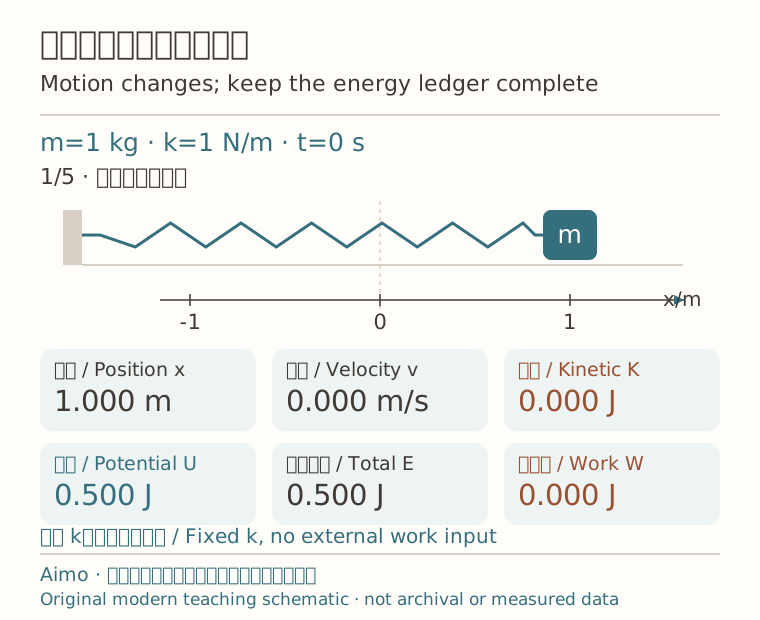
前四步推进同一弹簧振子的时间,最后一步停在同一瞬间,由外界改变刚度。比较x、v、K、U、E与外部累积功W六项读数;重置返回释放时刻。第四步为突变前,第五步为突变后,二者没有经过额外时间。
The first four steps advance time for one spring oscillator. The last stays at the same instant while an external actuator changes stiffness. Compare x, v, K, U, E and cumulative external work W; Reset returns to release. Step four is before the quench and step five immediately after, with no extra elapsed time.
释放:势能最多Release: maximum potential energy
1 / 5t=0 s,m=1 kg,k=1 N/m。从x=1 m、v=0释放,K=0,U=E=0.500 J,累积外部功W=0。振子即将运动;自主规律不要求质点停在原处。
At t=0 s, m=1 kg and k=1 N/m, release from x=1 m and v=0. K=0, U=E=0.500 J and cumulative external work W=0. The oscillator is about to move; an autonomous law does not require a fixed particle position.
- 位置 xPosition x
- 速度 vVelocity v
- 动能 KKinetic energy K
- 势能 UPotential energy U
- 总机械能 ETotal mechanical energy E
- 累积外部功 WCumulative external work W
模型边界Model boundary
模型边界:一维无耗散振子,m=1 kg,k₀=1 N/m,x₀=A=1 m,v₀=0,ω₀=√(k₀/m)=1 s⁻¹。自主段取闭式解x=Acos(ω₀t)、v=−Aω₀sin(ω₀t),不使用数值积分;四帧t=0、π/4、π/2、3π/4 s的K+U均为0.500 J。第五帧仍在t=3π/4 s,外部致动器理想地把k由1改为2 N/m,假定没有冲量,因此x、v连续、K=0.250 J不变,U从0.250升为0.500 J,E从0.500升为0.750 J。累计外部功W由0变为+0.250 J。对L=mv²/2−k(t)x²/2,dE/dt=−∂L/∂t=½k̇x²;参数跳变的理想功积分为W外=½Δkx²。振子子系统接受源的功,完整账目须包含源的能量减少。改变外部参数后不能沿用旧自主段的能量守恒结论。这里只是经典力学的受限示例,不是诺特定理的证明;规律的时间平移不意味着质点位置恒定。未模拟致动器细节、有限切换过程或耗散;全部中间计算保持精度,显示值才舍入。[1,4,5]
Model boundary: one undamped dimension, m=1 kg, k₀=1 N/m, x₀=A=1 m, v₀=0 and ω₀=√(k₀/m)=1 s⁻¹. The autonomous segment uses the closed-form x=Acos(ω₀t), v=−Aω₀sin(ω₀t), without numerical integration. K+U is 0.500 J at t=0, π/4, π/2 and 3π/4 s. The fifth frame remains at t=3π/4 s while an ideal external actuator changes k from 1 to 2 N/m with no impulse. Thus x and v are continuous and K stays 0.250 J; U rises from 0.250 to 0.500 J and E from 0.500 to 0.750 J. Cumulative external work W rises from 0 to +0.250 J. For L=mv²/2−k(t)x²/2, dE/dt=−∂L/∂t=½k̇x²; the ideal jump-work integral gives Wext=½Δkx². The oscillator subsystem receives source work, and full accounting includes the source’s energy decrease. The old autonomous conservation conclusion cannot simply be carried through an external parameter change. This restricted classical illustration is not a proof of Noether’s theorem; time-translation symmetry of a law does not fix the particle’s position. Actuator details, finite switching dynamics and dissipation are omitted. Only displayed values are rounded.[1,4,5]
五个状态,一本能量账
Five states and one energy ledger
取无摩擦理想振子,质量m=1kg,刚度k=1N/m,从x=1m、v=0释放。以秒为t的数值单位,解析解为x=cos(t)m、v=−sin(t)m/s。取U=½kx²,K=½mv²,这些数值是教学设定,不是历史实验记录。[5]
Choose an ideal frictionless oscillator with m = 1 kg and k = 1 N/m, released at x = 1 m with v = 0. With t measured numerically in seconds, x = cos(t) m and v = −sin(t) m/s. We use U = ½kx² and K = ½mv². These are teaching choices, not historical measurements. [5]
先看t=0、π/4、π/2、3π/4秒四个状态。K依次为0、0.25、0.5、0.25J,U依次为0.5、0.25、0、0.25J,总和E始终0.5J。位置与速度明显不同,机械能却相同;不变的量藏在变化之中。
At t = 0, π/4, π/2 and 3π/4 seconds, K is respectively 0, 0.25, 0.5 and 0.25 J, while U is 0.5, 0.25, 0 and 0.25 J. Their sum E stays at 0.5 J. Position and velocity differ, yet mechanical energy remains unchanged.
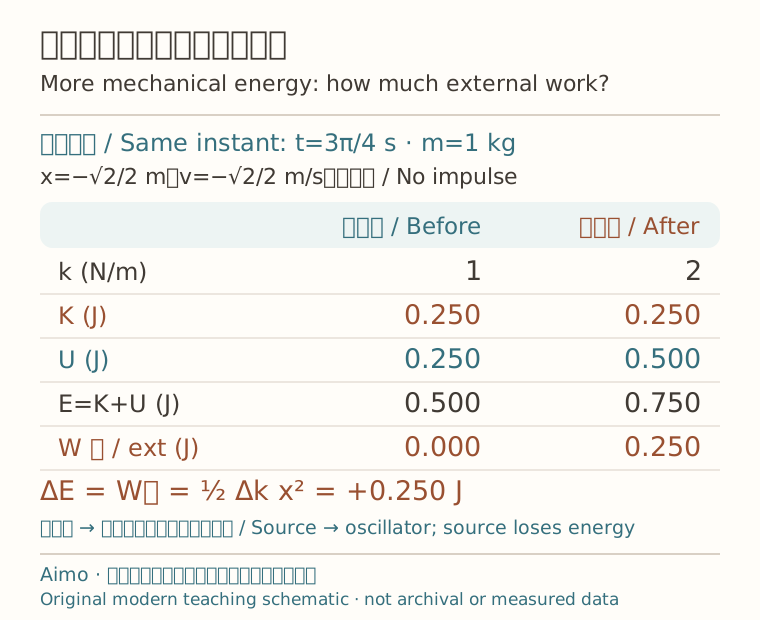
第五步停在最后一个时刻,由外界把k从1瞬时调到2N/m。假定没有冲量,x与v连续,仍分别为−√½m、−√½m/s。K保持0.25J,U升至0.5J,E升至0.75J。改变的是系统参数,不是给速度凭空加一跳。
The fifth step is immediately after an external change of k from 1 to 2 N/m at the last time. Assuming no impulse, x and v remain continuous at −√½ m and −√½ m/s. K stays 0.25 J, U rises to 0.5 J and E to 0.75 J. A system parameter changes without a jump in velocity.
多出的0.25J由调节刚度的外部装置做功提供,累计外功W从0变成+0.25J。只把滑块和弹簧圈为研究对象,它就是接受功的开放子系统。把装置及能源也纳入封闭总系统,账本还须记下相应转出的能量。
The extra 0.25 J is work supplied by the stiffness actuator: cumulative external work W changes from zero to +0.25 J. The block and spring form a subsystem open to work. A closed total system including the actuator and its energy supply must also account for the corresponding energy transferred out.
先问规律,再问边界
Ask about the law, then the system boundary
对指定的L=½mv²−½k(t)x²,沿运动方程求导可得dE/dt=−∂L/∂t=½k̇x²。变刚度使振子描述显含时间;瞬时跳变是参数做功积分的理想极限。机械能增加正是外功入账,不能称为整个系统凭空造能。
For the specified L = ½mv² − ½k(t)x², differentiation along the equations of motion gives dE/dt = −∂L/∂t = ½k̇x². Varying stiffness introduces explicit time dependence. The jump is an ideal limit of the parameter-work integral: the mechanical-energy increase records incoming work.
这个例子也提醒我们,系统边界、外界驱动和数学条件都不是脚注。它说明经典振子中的一种联系,不能外推成所有时空、所有系统都有同一种全局能量。诺特论文的范围与条件,比一句对称导致守恒丰富得多。[1]
System boundaries, external driving and mathematical conditions are part of the argument. This example illustrates one classical oscillator, without asserting the same global energy for every system and spacetime. Noether's paper has a scope and conditions much richer than the slogan that symmetry implies conservation. [1]
诺特1935年去世。她留下的视角仍可用于一次检查:哪一种连续变换保持作用量,哪个量因此恒定;若读数变了,又有哪些条件或能量通道改变?理解守恒,也是在学习怎样提出更准确的问题。[1,3]
Noether died in 1935. Her perspective still guides a check: which continuous transformation preserves the action, and which quantity consequently stays constant? If a reading changes, which assumptions or energy channels changed? Understanding conservation also means learning to ask more precise questions. [1,3]
参考资料 / References
- E. Noether, Invariante Variationsprobleme, Nachrichten der Gesellschaft der Wissenschaften zu Göttingen, Math.-phys. Klasse, 235–257 (1918)原始论文的哥廷根大学图书馆扫描;连续群、变分问题、两个定理及其条件。原文与后来的英译共用此编号。 / Original paper scanned by SUB Göttingen; continuous groups, variational problems, the two theorems and their conditions. Later translations share this source ID.
- University of Göttingen, Emmy Noether (1882 to 1935)机构传记:1907年博士、1915年受邀至哥廷根、授课资格受阻与1919年资格、1933年失去职位及美国任教。 / Institutional biography: doctorate in 1907, invitation to Göttingen in 1915, habilitation barriers and success in 1919, loss of post in 1933 and subsequent teaching in the United States.
- Bryn Mawr College, Remembering Emmy Noether机构记录核对1933年加入布林莫尔与1935年去世;不把2025年纪念活动写成当年的新闻。 / Institutional record confirming her arrival at Bryn Mawr in 1933 and death in 1935; the 2025 remembrance is not presented as contemporary news.
- D. Tong, Classical Dynamics, §2 The Lagrangian Formalism, University of Cambridge官方讲义:作用量、欧拉—拉格朗日方程、连续对称性、不显含时间与能量;本文采用明确的经典力学范围。 / Official lecture notes on action, Euler–Lagrange equations, continuous symmetry and energy without explicit time dependence; this article uses a stated classical-mechanics scope.
- OpenStax, University Physics Volume 1, §15.2 Energy in Simple Harmonic Motion官方开放教材:无耗散简谐振子的K、U与机械能。本文参数、五状态和外部变刚度账本为原创教学计算。 / Official open textbook on K, U and mechanical energy in undamped simple harmonic motion. Parameters, five states and the external stiffness-work ledger are original teaching calculations.