 Aimatra
科学人物 04 / PEOPLE IN SCIENCE 04
白光为什么能分出颜色?——牛顿与棱镜里的线索
Why Can White Light Split into Colours? — Newton and the Clues in a Prism
一条彩带、两块棱镜,以及把“制造颜色”改写为“分开颜色”的证据A coloured band, two prisms, and the evidence that changed making colours into separating them
一条彩带留下的疑问
The question left by a coloured band
一束日光穿过透明棱镜,在墙上展开红到紫的彩带。玻璃看起来没有颜色,进去的光也近乎白色:这些颜色究竟从哪里来?若只看这一幕,我们还分不清,是玻璃给光染了色,还是它让原本混在一起的东西显了形。[1]
A beam of sunlight passes through a transparent prism and spreads into a band from red to violet on a wall. The glass looks colourless and the entering light nearly white. Where have the colours come from? This scene alone does not tell us whether the glass has coloured the light or revealed components already mixed together. [1]
1672年2月6日,牛顿从剑桥寄出一封讨论光与颜色的信,后来刊于英国皇家学会的《哲学汇刊》。信中回述,他起初让日光从窗板小孔进入暗室,再穿过三棱镜;使他停下来追问的,是墙上光斑竟然被拉得很长。[1]
On 6 February 1672, Newton sent a letter from Cambridge about light and colours, later published in the Royal Society's Philosophical Transactions. He recalled admitting sunlight through a small hole in a shutter into a dark room and passing it through a triangular prism. What made him stop and investigate was the unexpectedly elongated patch of light on the wall. [1]
颜色吸引目光,异常的形状却逼人检查解释。若入射的光性质相同,为什么出射方向能散开这么多?牛顿把欣赏变成了追查:先改变玻璃厚度、小孔大小和棱镜的位置,看看彩带是否只是装置偶然留下的痕迹。[1]
Vivid colours invite admiration; an unexpected shape demands an explanation. If the entering light were uniform in its properties, why would its outgoing directions spread so widely? Newton turned looking into investigation, varying the glass thickness, hole size and prism position to test whether the band was an accidental effect of the apparatus. [1]
再放一块棱镜,问题就变了
A second prism changes the question
排除几项装置因素,还不足以读出光的组成。一块棱镜同时处理整束日光,许多变化挤在一起。下一步需要让光“单独作答”:先把彩带展开,再只取其中很窄的一段,送到另一块棱镜面前。[1]
Eliminating a few apparatus effects was not enough to establish the composition of light. One prism acts on the whole sunlight beam, combining many changes in a single view. The next step was to let a selected part answer: spread out the band, admit only a very narrow portion, and send it to another prism. [1]
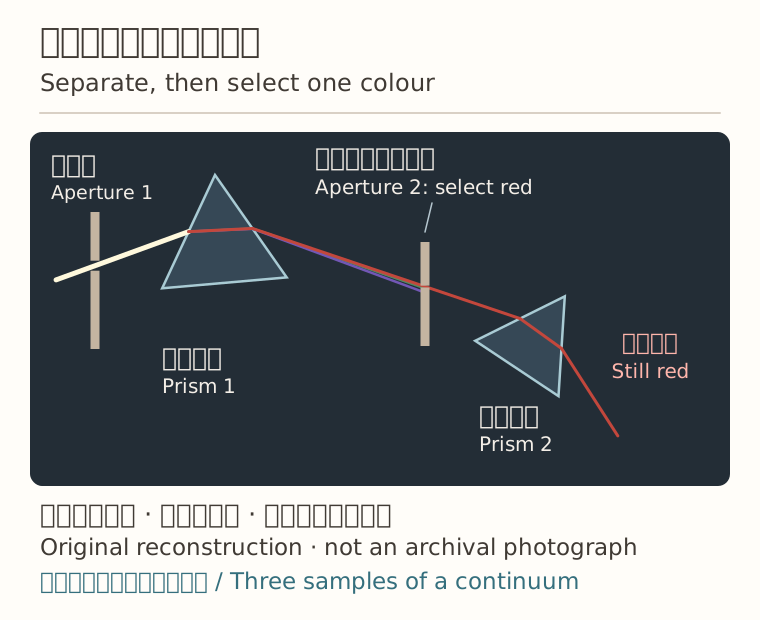
牛顿所称的“关键实验”用了两块带孔木板与第二块棱镜。小孔限制能通过的光路;他缓缓转动第一块棱镜,让彩带的不同部分依次经过后方小孔,再观察它们经第二块棱镜后落在墙上的位置。[1]
What Newton called his experimentum crucis, or crucial experiment, used two boards with holes and a second prism. The holes restricted the admitted path. He slowly turned the first prism so that different portions of its coloured image passed successively through the farther hole, then observed where the second prism sent them on the wall. [1]
这样的安排不只是让颜色再走一遍玻璃,而是尽量保持第二块棱镜处的入射条件相同,再比较不同色光的偏折。原先偏折较大的那部分,在第二次比较中仍偏折较大;差别随着选中的光而来,并未随机换位。[1,2]
The arrangement did more than send colours through glass again. It kept the incidence conditions at the second prism as nearly alike as possible while comparing how different coloured portions bent. The portion refracted more strongly in the first comparison was again refracted more strongly in the second. The difference travelled with the selected light rather than changing places at random. [1,2]
在后来回应质疑时,牛顿特意说明,这个比较的要点,是不同色光分别以相同入射角照来,仍发生不同程度的折射。证据的力量来自控制条件:新的问题让不同解释能够接受同一场比较。[2]
Answering criticism later, Newton stressed the point of this comparison: different coloured rays, considered separately at equal incidence, underwent unequal refraction. Its force lay in controlling the conditions: the new question made it possible to put different explanations through the same comparison. [2]
红光没有再变成一条彩虹
Red light does not become another rainbow
另一个关键观察与它相互支撑:把分离得足够好的红光再送入棱镜,它会改变方向,却仍保持红色,不会重新生出完整的红到紫彩带。若玻璃每次都把简单白光改造成各种颜色,这份顽固的“保留原色”就很难解释。[1]
Another important observation supported this result. Red light separated sufficiently well could change direction in another prism while remaining red, rather than producing a complete new red-to-violet band. If glass simply transformed uniform light into assorted colours on each passage, this persistent retention of colour would be difficult to explain. [1]
“足够好”不能省略。真实小孔选出的是有限宽度的色带,里面仍可能含有相邻成分,再折射时还可稍微展开。牛顿也提醒读者,未分离干净的混合光会有相应变化。因此,教学图里的一条红线,是窄带光的简化。[1]
The qualification sufficiently well matters. A real aperture selects a band of finite width that can still contain neighbouring components and spread a little upon further refraction. Newton warned that incompletely separated mixtures could show corresponding changes. A single red line in a teaching diagram is therefore a simplification of narrow-band light. [1]
反过来,把展开的各部分按适当比例重新汇到同一区域,又能得到近乎白色的光。牛顿在信末描述用透镜收集这些光,并移动白纸寻找混合最充分的位置;若某些颜色没进入透镜,白色就会受到影响。[1]
Conversely, bringing the separated portions together in suitable proportions can recover nearly white light. At the end of his letter, Newton described collecting them with a lens and moving white paper to find the position of fullest mixture. If some colours missed the lens, the resulting whiteness was affected. [1]
合成白光需要合适的光路与重叠条件,任意两块棱镜摆在一起并不保证成功。分开、选择、再比较、重新混合,共同指向一个新解释:白光已经包含多种成分,棱镜把它们按不同的偏折程度分开。[1]
Recovering white light requires an appropriate optical arrangement and overlap; placing any two prisms together does not guarantee success. Separation, selection, comparison and recombination jointly supported a new explanation: white light already contains different components, and a prism separates them through their unequal refraction. [1]
教学机制示意
Teaching schematic
五步看懂:棱镜怎样分开已有颜色Five steps: how a prism separates existing colours
五幅图拆解同一静态光学过程;它们是教学阶段,不是等时间间隔的波传播动画。前四步读数中的红 / 紫依次指 700 / 400 nm;折射率和总偏向是整条路径的模型预测,在各阶段保持一致。最后一步只保留选出的红光。
Five diagrams unpack one static optical process; these are teaching stages, not equal-time frames of wave propagation. In the first four steps, red / violet means 700 / 400 nm. The medium indices and total deviations are whole-path model predictions and remain the same across stages. The final step retains only selected red.
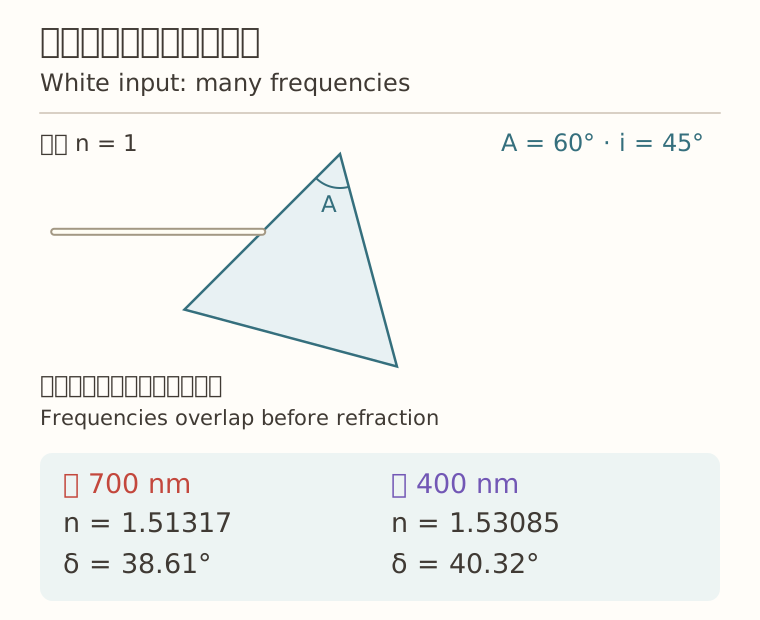
白光进入:含有许多频率White input: many frequencies
1 / 5此处的日光白光包含连续范围的频率;图中只抽取 700、550、400 nm 三个离散样本。红光与紫光的频率分别为 428.27、749.48 THz。此时尚未发生界面折射。
The sunlight modeled here contains a continuous range of frequencies; the drawing samples only 700, 550, and 400 nm. The red and violet frequencies are 428.27 and 749.48 THz. No interface refraction has occurred at this optical stage.
- 红 / 紫 真空波长Red / violet vacuum wavelength
- 红 / 紫 介质折射率(模型)Red / violet medium index (model)
- 红 / 紫 整块棱镜总偏向(模型)Red / violet total prism deviation (model)
- 红 / 紫 频率Red / violet frequency
- 入射角 iIncidence angle i
模型边界Model boundary
模型边界:外界 n = 1;静止、透明、线性、无损棱镜;A = 60°,i = 45°。λ 用真空波长,示例两项 Cauchy 公式 n(λ) = 1.5046 + 0.00420/λ²,式中 λ 以 μm 计,只在 400–700 nm 使用;系数不是实际玻璃标定或牛顿测量。r₁ = asin(sin i/n),r₂ = A − r₁,e = asin(n sin r₂),δ = i + e − A。入射角与折射角均相对各自界面法线量取;全反射和无效输入会被拒绝。f = c/λ真空,v相 = c/n,λ内 = λ真空/n,E光子 = hf。选色采用单一波长极限;不计算强度、反射、吸收或群速度。显示读数四舍五入。
Model boundary: surrounding n = 1; a stationary transparent linear lossless prism; A = 60°, i = 45°. Lambda denotes vacuum wavelength. The illustrative two-term Cauchy formula n(λ) = 1.5046 + 0.00420/λ² uses λ in μm and only 400–700 nm; its coefficients are neither a glass calibration nor Newton measurements. r₁ = asin(sin i/n), r₂ = A − r₁, e = asin(n sin r₂), δ = i + e − A. Incidence and refraction angles are measured from their respective interface normals; total internal reflection and invalid inputs are rejected. f = c/λvacuum, vphase = c/n, λmedium = λvacuum/n, Ephoton = hf. Selection is the single-wavelength limit. Intensities, reflections, absorption, and group velocity are not modeled. Display readings are rounded.
方向的改变,怎样成为颜色的展开
How a change of direction spreads colours apart
现在换用现代光学语言。光从空气斜入玻璃,一般会改变传播方向,这叫折射。用折射率n描述介质,光的相速度为v=c/n。下方示意采用现代光线模型来说明机制,并非声称重现了牛顿当年的全部测量数据。[3]
Now switch to modern optics. Light entering glass obliquely from air generally changes its propagation direction: refraction. With refractive index n, its phase speed is v = c/n. The schematics below use a modern ray model to explain the mechanism; they do not claim to reproduce Newton's complete original measurements. [3]
每个界面上的方向由斯涅尔定律联系:n₁sinθ₁=n₂sinθ₂,角度从界面的法线量起。棱镜两个透光面不平行,光在进入和离开时分别折射,最后方向取决于两次折射与棱镜几何,不能只画第一道转弯。[3,4]
At each interface, Snell's law relates the directions: n₁ sin θ₁ = n₂ sin θ₂, with both angles measured from the surface normal. A prism's transmitting faces are not parallel. Light refracts on entry and exit, so its final direction depends on both refractions and the prism geometry, rather than only the first turn. [3,4]
若所有成分对应的折射率完全一样,光束可以偏折,却不会因此展开颜色。普通玻璃在可见光的正常色散范围内,对紫光的折射率通常比红光大,于是常见棱镜光路里紫光总体偏折更多。这种传播性质随频率变化,才是色散。[4]
If every component had exactly the same refractive index, the beam could bend without spreading into colours. In the visible normal-dispersion range of ordinary glass, the index is generally greater for violet than for red, so violet undergoes a greater overall deviation in the familiar prism arrangement. Dispersion is this dependence of propagation properties on frequency. [4]
太阳光展开的可见光谱也不是七条互不相通的硬色带。红、橙、黄、绿、蓝、靛、紫是便于辨认和命名的区域,色调之间连续过渡。图上挑选几条彩线,是为了追踪代表性光路,不能把省略的中间成分当成不存在。[4]
The visible spectrum spread from sunlight is not seven disconnected, sharply bounded bands. Red, orange, yellow, green, blue, indigo and violet name convenient regions within a continuous transition of hues. A diagram selects a few coloured rays so that representative paths can be followed; the omitted intermediate components still exist. [4]
棱镜改变了什么,又保留了什么
What the prism changes, and what it preserves
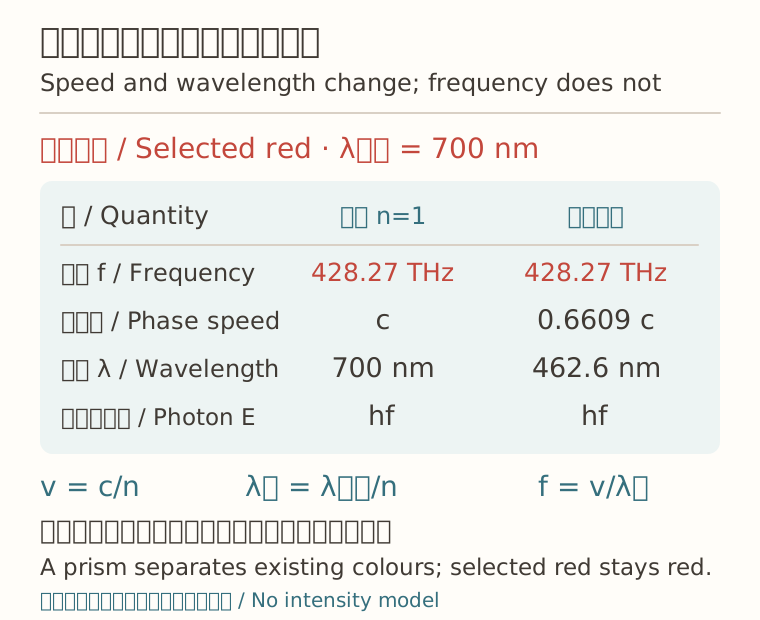
在静止、性质不随时间变化的线性界面,入射光与透射光的频率f相同。进入玻璃后,改变的是相速度与介质内波长,λ=v/f;不能因为波长缩短,就说红光变成了紫光。比较颜色对应的波长时,要说明使用真空波长。[5]
At a stationary linear interface whose properties do not change with time, incident and transmitted light have the same frequency f. Entering glass changes the phase speed and the wavelength within the medium, related by λ = v/f. A shorter wavelength there does not turn red light violet. Wavelengths used to identify spectral colours should be specified as vacuum wavelengths. [5]
能量也没有被棱镜凭空添上。现代量子语言用E=hf表示单个光子的能量;上述频率不变的过程中,它不会因偏折而升级。理想无损棱镜重新分配光的传播方向;真实装置还会反射或吸收部分光,透射彩带并不比入射光多出能量。[3,5,6]
Nor does the prism supply energy from nowhere. In modern quantum language, a photon's energy is E = hf; bending in the frequency-preserving process above does not raise it. An ideal lossless prism redistributes propagation directions. A real apparatus also reflects or absorbs some light, and the transmitted coloured band gains no extra energy over the entering light. [3,5,6]
牛顿的棱镜实验由此留下了比彩虹更耐看的东西:一种把混合现象拆开追问的方法。它并没有独自解决光究竟是什么的全部问题。它使一个较小却扎实的答案站住了脚:看似单纯的白色,可以来自许多不同成分的共同到达。[1,2]
Newton's prism experiments leave something more enduring than a rainbow: a way of taking a mixed phenomenon apart and questioning its components. They did not by themselves settle every question about the nature of light. They established a smaller, substantial answer: apparently simple white light can result from different components arriving together. [1,2]
参考资料 / References
- Isaac Newton · A Letter … containing his New Theory about Light and Colors (1672) · The Newton Project皇家学会《哲学汇刊》原文的校订转录:信署1671/72年2月6日;暗室、拉长光谱、两孔板与第二棱镜、充分分离后的色光、透镜合成白光及其条件。正文将年份写作1672,不将现代频率语言归于牛顿。
- Isaac Newton · Letter to Henry Oldenburg, dated 11 [June] 1672 · Cambridge University Library MS Add. 3976 · The Newton Project牛顿回应胡克的手稿转录,明确关键实验比较不同色光在相等入射条件下的不同折射;也区分实验命题与关于光之本性的机械假说。转录标题日期带编辑方括号,正文不引用其具体月日。
- OpenStax · University Physics Volume 3 · 1.3 Refraction折射率、v=c/n、斯涅尔定律、角度相对法线的定义,以及界面反射与透射的区别。文中只使用这些现代基础关系,不将其数值例题作为牛顿实验数据。
- OpenStax · University Physics Volume 3 · 1.5 Dispersion色散、普通玻璃可见光范围内折射率随波长变化、棱镜两界面折射与紫光较大偏折,以及可见光谱颜色的连续过渡。
- UNSW School of Physics · Physclips: Snell's law and refraction界面处波峰连续通过,入射与透射频率相同,速度变化导致介质内波长变化。本文明确限定静止、时间不变的线性光学情形,并用v表示介质中的相速度。
- OpenStax · University Physics Volume 3 · 6.2 Photoelectric Effect现代光子关系E=hf;与频率不变共同说明普通无源线性棱镜不会因折射提高单个光子的能量。能量说明属于现代解释,不是牛顿1672年采用的语言。