 Aimatra
科学人物 06 / PEOPLE IN SCIENCE 06
光究竟是什么在振动?——麦克斯韦与电磁波
What Is Oscillating in Light? — Maxwell and Electromagnetic Waves
从电磁测量中的一个速度,到穿过真空的场与能量From a speed hidden in electrical measurements to fields and energy crossing a vacuum
没有水,什么在起伏
What can wave without water?
水波让水面起伏,声音让空气疏密交替。那么,阳光穿过近乎真空的太空时,究竟是什么在振动?干涉告诉我们光具有波的性质,却还没有回答波由什么组成。麦克斯韦把这个问题带进了电与磁的世界。[3,4]
Water waves disturb a surface; sound alternately compresses and rarefies air. What, then, oscillates as sunlight crosses the near vacuum of space? Interference tells us that light has wave properties, but does not identify what makes up the wave. Maxwell brought that question into the world of electricity and magnetism. [3,4]
詹姆斯·克拉克·麦克斯韦关注的不只是带电物体怎样相互吸引,还包括它们周围的空间。他的《电磁场的动力学理论》于1864年12月8日在英国皇家学会宣读,全文发表于1865年。场成为论证的主角。[1]
James Clerk Maxwell considered more than the attraction between charged bodies: he also examined the space around them. His A Dynamical Theory of the Electromagnetic Field was read at the Royal Society on 8 December 1864, and the full paper appeared in 1865. The field became central to the argument. [1]
这里的“场”描述空间各处的电磁状态,不是一张藏在暗处的网。麦克斯韦要问:由电磁实验建立的规律,能否同时解释光的传播?下文使用现代记号讲解;今天常见的四条矢量方程,并非他那篇论文的原样排版。[1,3]
A field describes the electromagnetic state at different places; it is not a hidden mesh. Maxwell asked whether laws established from electromagnetic experiments could also explain light's propagation. We use modern notation below. The familiar set of four vector equations is not the form in which his paper originally presented its theory. [1,3]
电磁测量里出现了光速
A speed emerges from electrical measurements
法拉第的感应规律把变化的磁场与电场联系起来。麦克斯韦又把电场随时间的变化纳入磁场规律,用“位移电流”项补充传导电流。电容器充电时,两极板之间可以有这项贡献,并不要求电子穿过绝缘间隙。[3]
Faraday's induction law connects a changing magnetic field with an electric field. Maxwell incorporated time variation of the electric field into the magnetic law, adding a displacement-current term alongside conduction current. Between the plates of a charging capacitor, this contribution does not require electrons to cross the insulating gap. [3]
把这些关系联立,得到的不只是静止的力场,也有能够传播的扰动。空间中场的变化与时间中场的变化相互约束,形成波动方程。因此,“电先变成磁、磁再追上电”的接力故事,会误导我们对一列行波的理解。[3,4]
Taken together, these relations allow propagating disturbances as well as static fields. Spatial and temporal variations constrain one another, giving a wave equation. A relay story in which electricity first turns into magnetism and magnetism then catches up therefore misrepresents a traveling wave. [3,4]
用现代真空记号,波速为c=1/√(ε₀μ₀),其中两项分别是电常数与磁常数。麦克斯韦在论文中比较电磁测量给出的速度与独立的光速测量,发现它们足够接近;这不是先把光速填进公式,再宣布两者相等。[1,4]
In modern vacuum notation, the wave speed is c = 1/√(ε₀μ₀), where the two constants describe the electric and magnetic properties of vacuum. In his paper, Maxwell compared a speed obtained from electromagnetic measurements with independent optical measurements and found sufficient agreement. He did not insert the optical speed first and then announce a match. [1,4]
理论给出的横向扰动,也与光的偏振性质相合。速度与方向两条线索,使“光是电磁扰动”成为有依据的推断。今天真空光速c的精确值是299792458米每秒;这是现代单位制中的定值,不能当作他当年的测量精度。[1,6]
The theory's transverse disturbances also agreed with light's polarization properties. Speed and direction together supported the inference that light is an electromagnetic disturbance. Today the exact value of c is 299792458 metres per second. This is a fixed value in the modern system of units, not the precision of Maxwell's historical measurements. [1,6]
两个场,同一列波
Two fields, one wave
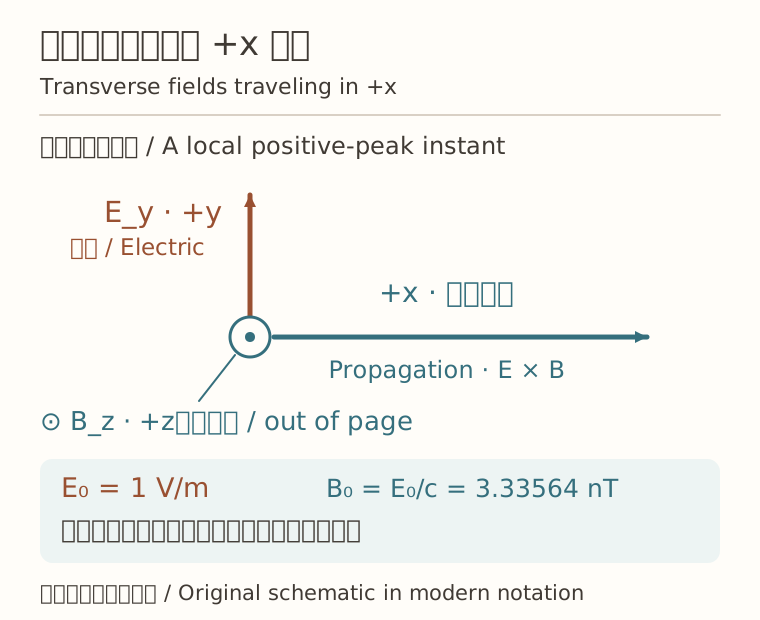
先选一个简单模型:真空中沿+x方向传播的正弦平面波。电场沿y轴,磁场沿z轴,二者彼此垂直,也都垂直于传播方向。图中弯曲的线连接各处场的读数,不是一根在太空里上下甩动的绳子。[4]
Choose a simple model: a sinusoidal plane wave traveling through vacuum in the +x direction. The electric field lies along the y axis and the magnetic field along the z axis. They are perpendicular to each other and to propagation. The plotted curves connect field readings at different locations; they are not ropes swinging through space. [4]
写成E_y=E₀cos(kx−ωt),便有B_z=E_y/c。k决定空间中的重复尺度,ω决定时间中的重复快慢。取E₀为1伏每米,只是教学选择;电场与磁场单位不同,图中分别除以各自振幅,才可比较相位。[4]
Writing E_y = E₀ cos(kx − ωt) gives B_z = E_y/c. The wavenumber k sets the spatial repetition and angular frequency ω the temporal repetition. Choosing E₀ = 1 volt per metre is simply a teaching choice. Electric and magnetic fields have different units, so each is divided by its own amplitude in the plots to compare phases. [4]
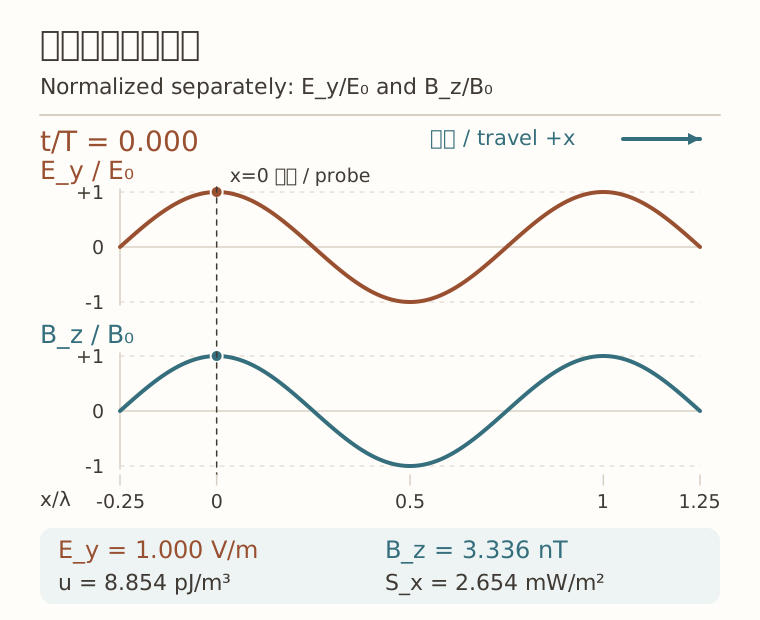
在这列行波中,两个场同相:它们的分量同时达到正峰、同时过零、同时变负。它们不会轮流消失,让另一个单独赶路。这个结论属于所选的真空行波,不能不加条件地推广到驻波或天线附近的所有场。[4]
In this traveling wave, the fields are in phase: their components reach positive peaks, cross zero and become negative together. They do not alternately disappear while the other travels alone. This result applies to the chosen vacuum traveling wave, and should not be generalized without qualification to standing waves or every field near an antenna. [4]
互动把位置写成x/λ,把时间写成周期T的份数。跟踪同一个波峰,就会看到它向+x移动;固定在x=0读数,则会看到场往复变化。前者是波形传播,后者是某处的振荡,不能把两种观察混成物质随波前进。[4]
The interaction expresses position as x/λ and time as fractions of the period T. Follow one crest and it moves toward +x; keep the probe at x = 0 and the fields oscillate. The first observation tracks propagation of a pattern, the second oscillation at a place. Neither means that matter is carried forward with the wave. [4]
教学机制示意
Teaching schematic
五步观察:同相的场怎样携带能量Five steps: in-phase fields carrying energy
每次点击推进八分之一周期,五幅图覆盖半周期;可重置回起点。两条曲线分别显示 E_y/E₀ 和 B_z/B₀,固定探针始终位于 x=0。请同时比较场的符号、波形沿 +x 的平移,以及探针处的非负能量密度与能流。
Each click advances one eighth of a period; five images cover half a cycle and Reset returns to the start. Separate curves show E_y/E₀ and B_z/B₀, with the probe fixed at x=0. Compare the field signs, the waveform’s translation in +x, and the nonnegative local energy density and flux.
同时达到正峰值Positive field peaks
1 / 5固定探针 x=0。t/T=0 时,E_y=+1 V/m、B_z=+3.33564 nT,同时处于各自正峰值。图中两条曲线分别除以 E₀ 和 B₀;相同的归一化振幅不表示相同的实际单位或振幅。E 沿 y、B 沿 z,均与传播方向 x 垂直。
The fixed probe is at x=0. At t/T=0, E_y=+1 V/m and B_z=+3.33564 nT reach their respective positive peaks together. Each curve is divided by its own E₀ or B₀; equal normalized amplitude does not mean equal physical amplitudes or SI units. E lies along y and B along z, both transverse to x.
- 时间 t/TTime t/T
- 固定探针 x/λFixed probe x/λ
- 探针电场 E_yProbe electric field E_y
- 探针磁场 B_zProbe magnetic field B_z
- 探针总能量密度 uProbe total energy density u
- 探针能流 S_x(沿 +x)Probe flux S_x (in +x)
模型边界Model boundary
模型边界:均匀真空中的单色平面行波,是局部理想化,并非 Maxwell 原图或有限光源的总能量模型。取 E₀=1 V/m,λ=600 nm,c=299792458 m/s(精确定义),ε₀≈8.8541878188×10⁻¹² F/m,μ₀=1/(ε₀c²)。B₀=E₀/c≈3.33564 nT;T=λ/c≈2.00138 fs,k=2π/λ,ω=2π/T。E_y=E₀cos(kx−ωt),B_z=(E₀/c)cos(kx−ωt),同相且沿互相垂直的 y、z 方向。纵轴各自归一化,横轴为 x/λ;u=ε₀E²,S_x=(E_yB_z)/μ₀=cu≥0。忽略物质介质、吸收、束腰、有限脉冲和边界。仅显示读数经过四舍五入。
Model boundary: a monochromatic plane wave in uniform vacuum, used as a local idealization rather than Maxwell’s original drawing or a finite-source total-energy model. E₀=1 V/m, λ=600 nm, c=299792458 m/s exactly, ε₀≈8.8541878188×10⁻¹² F/m, and μ₀=1/(ε₀c²). B₀=E₀/c≈3.33564 nT; T=λ/c≈2.00138 fs, k=2π/λ, ω=2π/T. E_y=E₀cos(kx−ωt) and B_z=(E₀/c)cos(kx−ωt) have the same phase along perpendicular y and z axes. Each ordinate is normalized separately; the abscissa is x/λ. u=ε₀E² and S_x=(E_yB_z)/μ₀=cu≥0. Material media, absorption, beam waists, finite pulses and boundaries are omitted. Only displayed readings are rounded.
能量怎样向前走
How energy moves forward
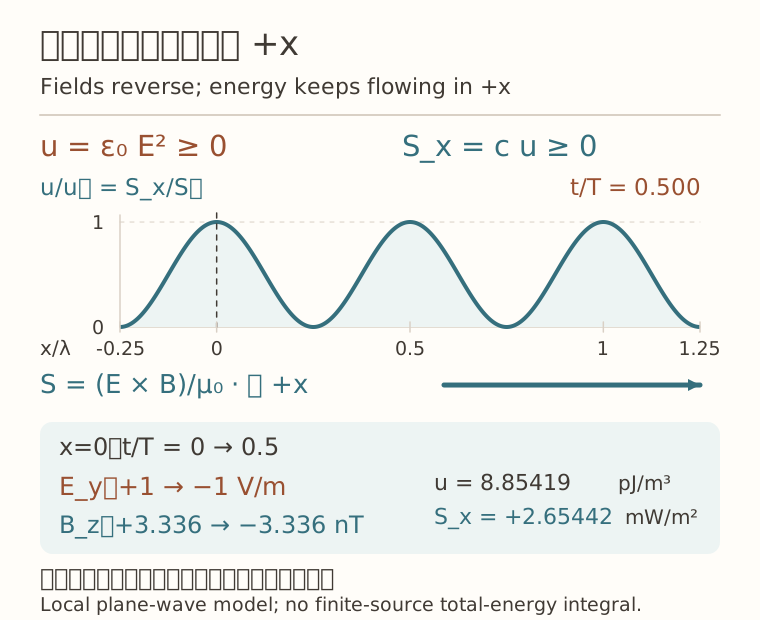
场不仅描述受力,也储存能量。总能量密度为u=ε₀E²/2+B²/(2μ₀)。代入这列波的B=E/c,电、磁两部分在每处每刻相等,总和为u=ε₀E²;能量并不在两者之间轮番交班。[5]
Fields describe forces and also store energy. The total energy density is u = ε₀E²/2 + B²/(2μ₀). Substituting B = E/c for this wave makes the electric and magnetic contributions equal at every place and time, with total u = ε₀E². Energy is not passed back and forth between the two contributions in alternating turns. [5]
能量穿过单位面积的快慢由坡印廷矢量描述,其方向由E×B决定。本模型中,能流大小S=EB/μ₀=cu。两个场同时反向时,叉积仍指向+x;场的正负在变化,能量流向却没有每半个周期倒转。[5]
The Poynting vector describes energy transport per unit area, with direction given by E × B. In this model its magnitude is S = EB/μ₀ = cu. When both fields reverse, their cross product still points toward +x. The fields change sign, but energy flow does not reverse every half-cycle. [5]
走到四分之一个周期,x=0处的两个场都为零,这里的瞬时能量密度与能流也为零。但别处仍有非零的场,波形继续前移。一个探针读到零,不等于整列波停止或能量被消灭;先看清读数属于哪里、哪个时刻。[4,5]
At one quarter-period, both fields at x = 0 are zero, as are the local instantaneous energy density and flux. Fields elsewhere remain nonzero, and the pattern continues forward. A zero at one probe does not mean that the entire wave has stopped or energy has been destroyed. Always identify the place and time of a reading. [4,5]
若把读数对完整周期平均,正弦行波的强度为I=ε₀cE₀²/2。振幅加倍,强度成为四倍。场能传播并不等于凭空造能:电磁波从源取得能量,遇到物体时可以传递能量;这里省略了源、吸收和有限光束边缘。[5]
Averaging over a complete period gives the sinusoidal wave intensity I = ε₀cE₀²/2. Doubling amplitude quadruples intensity. Propagating field energy does not create energy from nothing: a wave receives energy from its source and can transfer it to matter. Our model omits the source, absorption and the edges of a finite beam. [5]
让推断走向实验
Bringing a prediction to experiment
麦克斯韦的论文没有完成后来的全部实验检验。1887—1888年间,赫兹开展了一系列产生和探测电磁波的实验,并研究反射、折射与干涉。理论预言与实验验证相接,不能把赫兹的装置倒放进1865年的论文。[3]
Maxwell's paper did not perform all the experiments that later tested its predictions. In 1887–1888, Hertz conducted a series of experiments generating and detecting electromagnetic waves, and studied reflection, refraction and interference. Prediction and experimental testing connect across time; Hertz's apparatus should not be placed inside the 1865 paper. [3]
麦克斯韦也参与建设实验条件。作为剑桥首任卡文迪许实验物理学教授,他监督实验室的设计与建造,实验室于1874年开放。把看似抽象的方程与可重复的测量放在一起,是这段人物故事里同样值得记住的一面。[2]
Maxwell also helped build the conditions for experimental work. As Cambridge's first Cavendish Professor of Experimental Physics, he oversaw the laboratory's design and construction; it opened in 1874. Bringing abstract equations together with repeatable measurements is another part of his story worth remembering. [2]
再看光照进房间,不妨想一想:抵达这里的是不断变化的场,也是从源传来的能量。本文图像都是原创教学示意。它们把不可见的关系画出来;真正有分量的,是模型给出明确预言,而观察允许我们检验它。[4,5]
When light enters a room, think of changing fields arriving here, carrying energy from a source. Every illustration in this article is an original teaching schematic. It makes invisible relationships visible; what gives the model its force is that it offers definite predictions that observation can test. [4,5]
参考资料 / References
- Maxwell, J. C. A dynamical theory of the electromagnetic field. Philosophical Transactions of the Royal Society of London 155, 459–512 (1865).原始论文;1864年12月8日宣读、1865年全文刊出。第六部分 §§91–97 比较电磁扰动的横向性质与传播速度,形成光的电磁理论。Primary paper, read 8 December 1864 and published in full in 1865; Part VI §§91–97 compares transverse disturbances and electromagnetic/optical speeds.
- University of Cambridge, Cavendish Laboratory. Our history.首任卡文迪许实验物理学教授;监督实验室设计、建造,1874年开放。First Cavendish Professor of Experimental Physics; laboratory design, construction and opening in 1874.
- OpenStax. University Physics Volume 2, §16.1: Maxwell’s Equations and Electromagnetic Waves.位移电流与现代方程;赫兹对电磁波的产生、探测及波动性质的检验。Displacement current and modern equations; Hertz’s generation, detection and wave-property tests of electromagnetic waves.
- OpenStax. University Physics Volume 2, §16.2: Plane Electromagnetic Waves.真空平面行波的波速、横向性、同相的电磁场与E=cB;采用现代教学记号。Vacuum traveling plane waves: speed, transverse fields, equal phase and E=cB, in modern teaching notation.
- OpenStax. University Physics Volume 2, §16.3: Energy Carried by Electromagnetic Waves.场能密度、坡印廷矢量、瞬时能流与周期平均强度。Field energy density, Poynting vector, instantaneous flux and cycle-averaged intensity.
- NIST. 2022 CODATA adjustment: Fundamental Physical Constants — Extensive Listing.第1页:真空光速精确值299792458米每秒及真空介电常数推荐值;现代定值与十九世纪测量精度有别。Page 1: exact vacuum speed 299792458 m/s and the recommended vacuum permittivity; modern fixed values are distinguished from nineteenth-century measurement precision.