 Aimatra
科学人物 03 / PEOPLE IN SCIENCE 03
重的物体一定落得更快吗?——伽利略与下落的证据
Do Heavier Objects Always Fall Faster? — Galileo and the Evidence of Falling Bodies
从一个熟悉的直觉,到斜面、水钟与有条件的定律From a familiar intuition to inclined planes, water clocks and a law with conditions
眼睛看见的,究竟是什么
What are our eyes actually seeing?
把硬币和一张纸从桌边同时松开,硬币通常先到地面。“重的落得快”仿佛就在眼前。但这场比赛同时改变了质量、形状和空气的影响。我们看见了结果,却还没有分清是谁造成的;直觉要成为解释,还欠一次公平的比较。[5]
Release a coin and a sheet of paper together from a table edge, and the coin usually lands first. The claim that heavier things fall faster seems visible before us. Yet this contest changes mass, shape and the effect of air together. We have seen an outcome without separating its causes. Turning intuition into an explanation still requires a fair comparison. [5]
1589至1592年,伽利略在比萨大学教授数学,并开始撰写未曾出版的《论运动》。他那时也没有现成答案:早期曾用物体的比重解释下落,实验却没有顺从理论。后来熟悉的落体定律,是他多年修改观点与实验方法的结果。[1]
While teaching mathematics at the University of Pisa from 1589 to 1592, Galileo began the unpublished De motu, or On Motion. He did not already possess the answer. An early account linked falling motion to what we would call specific gravity, but experiments did not confirm it. His eventual law emerged through years of revising both ideas and experimental methods. [1]
他面对的也不是一个从未被怀疑的世界。在他之前,已有学者报告不同重量的物体几乎同时落地。真正困难的问题因此更尖锐:如果重量不能直接决定快慢,落下的物体怎样增加速度,又能用什么数量关系描述这个过程?[1]
Nor was he confronting a world in which nobody had questioned the received account. Earlier scholars had already reported that objects of different weights reached the ground nearly together. The harder question became more precise: if weight does not directly determine falling speed, how does a falling body gain speed, and what quantitative relationship describes that change? [1]
先让问题慢下来
First, slow the problem down
最有名的画面,是伽利略站在比萨斜塔上松开两个球。这个故事不宜当作已确证的现场记录。比起把发现压缩成一次戏剧性的胜利,更可靠的入口,是他1638年《两门新科学》中对装置和计时办法的描述。[2,3]
The best-known image shows Galileo releasing two balls from the Leaning Tower of Pisa. That story should not be treated as an established eyewitness record. A firmer starting point than a single dramatic victory is the description of apparatus and timing methods in his 1638 Discourses on Two New Sciences. [2,3]
他也用推理追问旧说:假定轻物总比重物慢,把两者绑在一起,轻物应当拖慢重物;可组合体又比重物更重,按同一规则反而该更快。这个矛盾动摇了简单的重量规则,却还没有替实验给出下落时间。[1]
Reasoning also put pressure on the older rule. Suppose a light body always falls more slowly than a heavy one. Bound together, the light body should retard the heavy body. Yet the combination is heavier still, so the same rule predicts that it should fall faster. This conflict undermines the simple weight rule; it does not itself supply a measured fall time. [1]
直接下落太快,难以细看。书中描述了一块开有直槽的长木板,槽内磨光并衬上光滑的羊皮纸,让圆整的铜球沿着缓坡滚下。斜面把短促的运动拉长,实验者才有机会比较不同路程所需的时间。[3]
A direct drop passes too quickly to inspect easily. The book describes a long board with a straight groove, polished and lined with smooth parchment, down which a round bronze ball rolled on a gentle incline. The slope stretched out the motion, giving the experimenter time to compare descents over different distances. [3]
计时也不必等候秒表。伽利略描述,把高处容器流出的细水收集起来,再称量每次下降期间接到的水。在水流足够稳定的条件下,水量的比值便可代表时间比值:看不见的时间,被换成了天平可以比较的量。[3]
Timing did not have to await a stopwatch. Galileo describes collecting a thin stream from an elevated vessel during each descent, then weighing the collected water. Provided the flow is sufficiently steady, ratios of water quantities represent ratios of elapsed times. Invisible duration becomes something a balance can compare. [3]
在一、四、九之间读出加速
Reading acceleration in one, four and nine
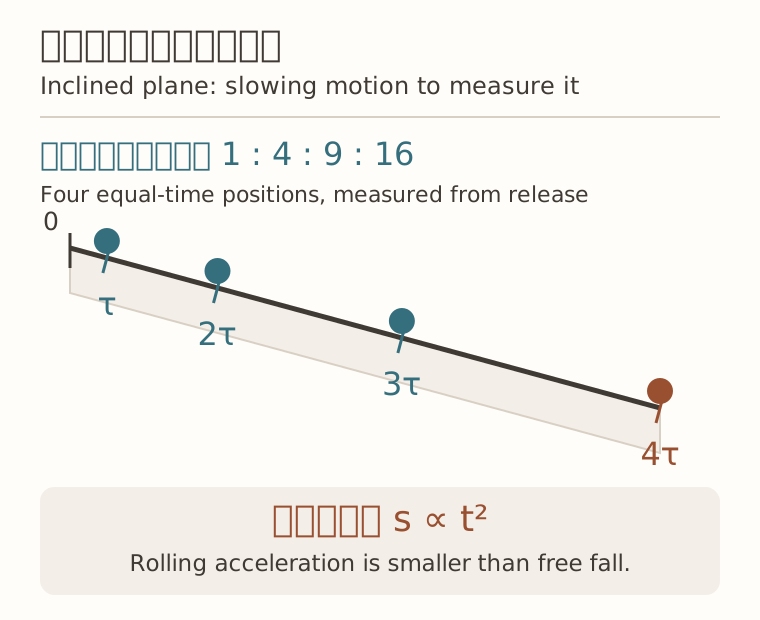
关键关系不是“时间加倍,路程加倍”。从静止出发,球滚过四分之一的路程,约需全程一半的时间;换成相等的时间单位,累计路程便按一、四、九增长。路程与时间平方成正比,说明运动一直在加快。[3,4]
The crucial relation is not that doubling time doubles distance. Starting from rest, the ball covers a quarter of the distance in about half the full descent time. For equal units of elapsed time, cumulative distances therefore grow as one, four and nine. Distance proportional to time squared describes motion that keeps gaining speed. [3,4]
把累计路程相减,每个相等时间段新增的路程,就是一、三、五。后一个时间段走得更远,并不意味着加速度越来越大;在匀加速运动中,速度每次增加相同的量,就足以产生这列不断变大的间距。[4,5]
Subtract successive cumulative distances and the distances added in equal time intervals are one, three and five. Covering more ground in each interval does not mean that acceleration is increasing. With constant acceleration, equal increments of speed already produce this widening sequence of spaces. [4,5]
这里要留一道边界:沿斜面滚动的球还在转动,不是竖直自由落体,不能把沿轨道测得的加速度直接写成重力加速度g。历史实验帮助辨认平方规律;下文的真空模型,则把研究对象与适用条件重新说清楚。[3,5]
A boundary matters here. A ball rolling down a slope also rotates; it is not in vertical free fall, and its acceleration along the track cannot simply be called the gravitational acceleration g. The historical experiment helps reveal the square-time relationship. The vacuum model below specifies a different physical situation and its conditions. [3,5]
伽利略博物馆还展示用小铃声标记等时间间隔的斜面装置,能让人“听见”间距增长。但馆方明确指出,没有存世文献证明伽利略做过这一个具体实验。教学模型能说明定律,不能因此自动成为他的原始仪器。[4]
Museo Galileo also displays an inclined-plane apparatus whose bells mark equal time intervals, making the growing spaces audible. The museum explicitly states that no surviving documents establish that Galileo performed this particular experiment. An apparatus may teach the law without being his original instrument. [4]
教学机制示意
Teaching schematic
五步看懂:质量在哪里消去,又在哪里保留Five steps: where mass cancels and where it remains
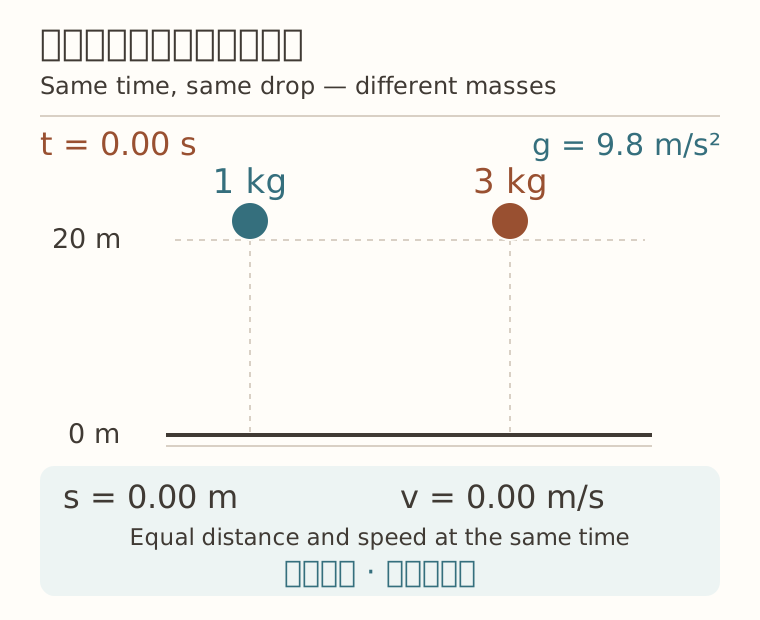
按步骤观察同一时刻的两个小球。图像与读数使用同一组模型计算;向下的位移、速度与加速度均取正值。
Compare both balls at the same instant in each step. Images and readings use the same model calculations. Downward distance, speed, and acceleration are positive.
同时静止释放Release together from rest
1 / 5两球从同一高度同时松手,初速度为零。1 kg 与 3 kg 球的重量不同,但各自的重量除以质量都给出同一加速度 g。
Both balls are released together at the same height with zero initial velocity. Their weights differ, but weight divided by mass gives the same acceleration g.
- 时间Time
- 两球下降距离Drop of both balls
- 两球剩余高度Height of both balls
- 两球向下速度Downward speed of both
- 两球向下加速度Downward acceleration of both
- 1 kg / 3 kg 重量1 kg / 3 kg weight
- 1 kg / 3 kg 势能1 kg / 3 kg potential energy
- 1 kg / 3 kg 动能1 kg / 3 kg kinetic energy
模型边界Model boundary
模型边界:近地面均匀 g = 9.8 m/s²;初始高度 h = 20 m;质量为 1 kg、3 kg;同时从静止释放;无空气阻力。s = ½gt²(不超过 h),v = gt,U = mg(h − s),K = ½mv²;地面势能为零。最后一步是 t → √(2h/g) 的触地前极限,仍保留向下速度,碰撞不在模型内。读数按显示精度四舍五入。
Model boundary: uniform near-Earth g = 9.8 m/s²; initial height h = 20 m; masses 1 kg and 3 kg; simultaneous release from rest; no air resistance. s = ½gt² (bounded by h), v = gt, U = mg(h − s), and K = ½mv², with zero potential energy at ground level. The last step is the pre-impact limit as t → √(2h/g), retaining downward velocity; collision is outside the model. Displayed readings are rounded.
同样的加速度,不同的力与能量
The same acceleration, different forces and energies
现在设想:在地表附近同一地点,忽略空气阻力,把g近似看作常量。两个小物体从同一高度、同一时刻由静止释放,就有相同的下落加速度,并同时到达同一地面。漏掉初速度或高度条件,这个比较便换了问题。[2,5]
Now consider two small objects near the same location on Earth's surface, neglect air resistance and approximate g as constant. Released simultaneously from rest at the same height, they have the same downward acceleration and reach the same ground together. Changing their initial velocities or heights changes the comparison. [2,5]
取向下为正,从释放时开始计时,速度v=gt,下落距离s=½gt²。式中没有落体的质量m:同一个g、同一个时间,就给出同样的速度和位移。这里相等的是加速度;速度从零开始增加,并非从松手起就保持不变。[5]
Taking downward as positive and measuring time from release, velocity is v = gt and distance fallen is s = ½gt². Neither expression contains the falling object's mass m: the same g and elapsed time give the same velocity and displacement. Acceleration is constant; velocity grows from zero rather than remaining fixed from release. [5]
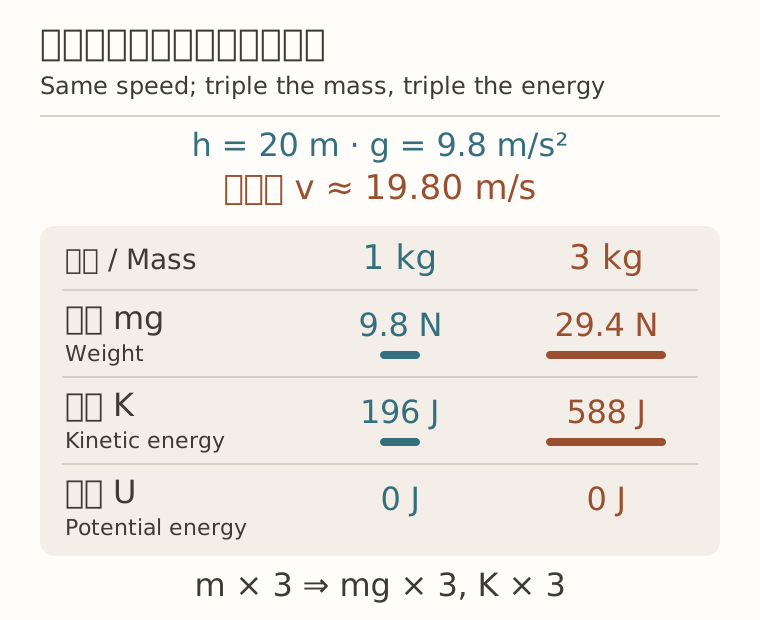
质量没有从物理中消失。用后来的牛顿力学解释,重力F=mg,质量加倍,重力也加倍;而同样的力使更大质量改变速度更困难。两者在a=F/m=mg/m=g中抵消。相同加速度,并不表示地球对它们施加相同的力。[2]
Mass has not vanished from physics. In the later Newtonian account, weight is F = mg: doubling mass doubles the gravitational force. A greater mass also requires more force for the same change of velocity. These factors cancel in a = F/m = mg/m = g. Equal acceleration does not mean that Earth exerts equal forces on the bodies. [2]
能量账也不同。下降同样高度h,物体与地球组成的系统减少的重力势能为mgh;忽略阻力,它转化成动能。较重物体到地面前可以有相同速度,却有更大的动能。于是“同时落地”,绝不等于“落地时带着同样多的能量”。[6]
Their energy accounts differ too. Descending through the same height h reduces the gravitational potential energy of the object–Earth system by mgh; without drag, that loss becomes kinetic energy. The heavier body can have the same speed just before reaching the ground while carrying more kinetic energy. Landing together does not mean arriving with equal energy. [6]
定律的力量,来自说清条件
A law gains strength from clear conditions
回到那张纸。空气中的物体还受到阻力,形状与迎风面积便会影响结果。把纸揉成团后再比较,目的不是让质量突然增加,而是改变空气作用的条件。现实中的先后次序,不能单凭“重”或“轻”两个字预测。[2,5]
Return to the paper. In air, drag also acts, making shape and the area presented to the air relevant. Comparing a crumpled sheet with the original is not about suddenly increasing its mass; it changes the conditions governing air's effect. The order of arrival in a real drop cannot be predicted from the words heavy and light alone. [2,5]
同样,g不是宇宙各处统一的数字:它随地点和高度改变。我们把近地面短距离内的变化忽略,才得到这套恒定g的计算。定律里的条件不是多余的小字,而是告诉读者:哪些差别已经排除,何时需要更细致的模型。[2,5]
Likewise, g is not one number everywhere in the universe: it changes with location and altitude. Constant-g calculations neglect its variation over short distances near Earth's surface. Those conditions tell the reader which differences have been excluded and when a more detailed model is needed. [2,5]
伽利略留给我们的,因而不只是一句反直觉的结论。从滚下木槽的球,到称在天平上的水,研究者把难以分辨的快慢变成可以核对的比例。真正值得继承的动作,是在宣布答案之前,先造出一个让答案能够受检验的问题。[1,3]
Galileo's legacy is therefore more than a counterintuitive conclusion. From a ball rolling along a wooden groove to water weighed on a balance, difficult judgments of speed became checkable ratios. The enduring move is to shape a question whose answer can be tested before announcing what that answer must be. [1,3]
参考资料 / References
- Al Van Helden · The Galileo Project: On Motion · Rice University比萨任教时期、早期《论运动》、既有落体研究、组合物体推理及观点的逐步修正。
- NASA Glenn Research Center · Free Fall without Air Resistance斜塔故事的传说性质;无空气阻力模型、F=mg、a=F/m及恒定g近似。
- The Galileo Project · Galileo's Inclined Plane Experiment · Rice University1995年学生复现实验页面,直接引录伽利略1638年《两门新科学》的斜面与水钟描述;正文区分历史引文与后来的复现。
- Museo Galileo · Instruments: Inclined plane等时间间隔与奇数距离序列的教学装置;馆方明确说明没有文献证明伽利略做过这一具体铃铛实验。
- OpenStax · University Physics Volume 1 · 3.5 Free Fall忽略空气阻力的落体、相同初始条件、运动学方程以及g随位置变化。本文将向下取为正。
- OpenStax · University Physics Volume 1 · 8.1 Potential Energy of a System物体—地球系统的近地表重力势能差、mgh及无耗散时势能向动能的转化。