 Aimatra
科学人物 10 / PEOPLE IN SCIENCE 10
一张衍射图能告诉我们多少?——富兰克林与结构的证据
How Much Can One Diffraction Image Tell Us? — Franklin and Evidence for Structure
从DNA的衍射线索到两种同强度排列,理解测量怎样约束看不见的结构From DNA diffraction clues to two equal-intensity arrangements, explore how measurements constrain unseen structure
看见图样,还没有看见分子
Seeing a pattern before seeing a molecule
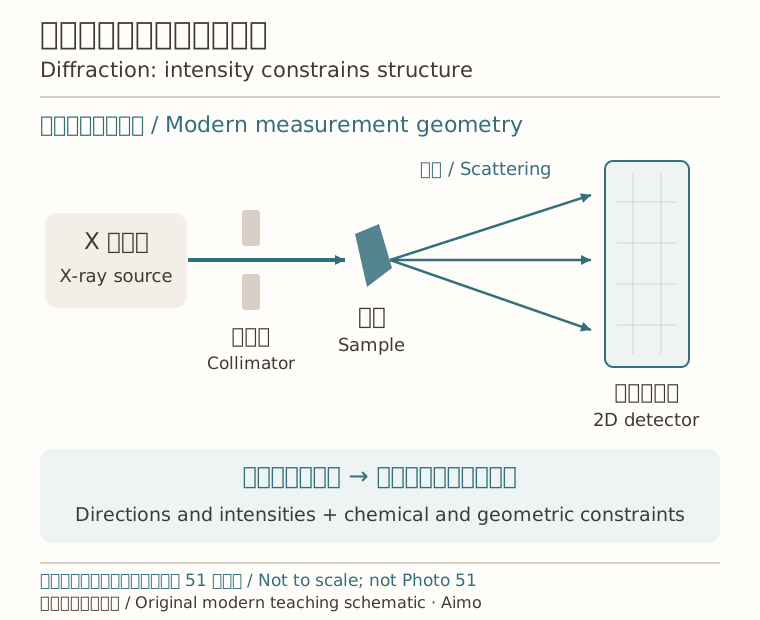
面对一张带有交叉斑纹的衍射图,我们很容易把它想成放大的分子照片。其实,探测器记录的是许多散射波叠加后的强度。斑点的位置与明暗藏着结构信息,却不是原子轮廓在纸上的直接投影。[4]
A diffraction image with crossing streaks can look like an enlarged photograph of a molecule. A detector actually records the intensity produced by many scattered waves adding together. The positions and brightness of its features carry structural information, rather than directly projecting atomic outlines onto a page. [4]
散射波走过不同路程,到达同一方向时可能加强,也可能抵消。知道波长、测量几何和样品条件,才能把斑纹变成距离与排列的限制。重复间隔留下有规律的信号,正是衍射可以充当微观尺子的原因。[4]
Scattered waves travel different paths and can reinforce or cancel in a given direction. Wavelength, measurement geometry and specimen conditions connect the pattern to constraints on distances and arrangements. Regular spacings leave regular signals, allowing diffraction to serve as a microscopic ruler. [4]
从一种排列算出图样,是正向问题;从图样推回排列,是逆向问题。后者还多一道检查:符合数据的答案是否只有一个?富兰克林参与的DNA研究,让我们同时看见高质量证据的力量,以及解释证据时必须交代的条件。[1,5]
Calculating a pattern from an arrangement is a forward problem; inferring an arrangement from a pattern is an inverse problem. The latter adds a question: is there only one answer consistent with the data? Franklin's DNA research illustrates both the power of good evidence and the assumptions needed to interpret it. [1,5]
富兰克林与戈斯林的证据
Franklin and Gosling's evidence
1952年5月,在伦敦国王学院,研究生雷蒙德·戈斯林在罗莎琳德·富兰克林指导下拍摄了著名的照片51。它来自高湿度下的B型DNA纤维。写下两人的名字,也是在承认制样、曝光与实验指导各自的劳动。[1,2]
In May 1952 at King's College London, graduate student Raymond Gosling made the famous Photo 51 under Rosalind Franklin's supervision. It came from B-form DNA fibres at high humidity. Naming both researchers recognises the work of specimen preparation, exposure and experimental direction. [1,2]
富兰克林与戈斯林比较了含水条件不同的A、B两种形态。纤维中许多分子的取向、湿度控制和图样分析,共同决定数据能说什么。她的贡献包含系统的实验与定量推断,不能压缩成偶然留下的一张漂亮照片。[1,2]
Franklin and Gosling compared A and B forms under different hydration conditions. Molecular alignment within the fibres, humidity control and pattern analysis all shaped what the data could establish. Her contribution encompassed systematic experiments and quantitative inference, beyond producing one striking image. [1,2]
1953年4月25日,《自然》同刊三篇论文:华生与克里克提出模型,威尔金斯、斯托克斯与威尔逊报告研究,富兰克林与戈斯林阐述衍射结果。模型构建与实验约束相互衔接,科学史中的署名也应保留这种具体分工。[1,2,3]
On 25 April 1953, Nature published three papers: Watson and Crick proposed a model; Wilkins, Stokes and Wilson reported their research; Franklin and Gosling presented diffraction results. Model building and experimental constraints connected, and historical attribution should retain these specific contributions. [1,2,3]
交叉图样支持螺旋结构,层线等特征约束重复尺度。但只凭一个X,不能唯一读出链数、碱基配对或全部原子坐标。富兰克林与戈斯林也结合含水、密度等考虑讨论结构;由螺旋线索走到完整模型,还需要别的证据。[1,3]
The cross supported a helical structure, while layer lines and other features constrained repeat distances. An X alone does not uniquely specify strand number, base pairing or every atomic coordinate. Franklin and Gosling also considered hydration and density; moving from helical clues to a complete model required additional evidence. [1,3]
先把问题缩成一排点
First reduce the question to a row of points
下面换用原创的一维点散射教学模型。所有点的实数散射振幅均为一,采用标量、相干与运动学近似,忽略多次散射等效应。这排点不是DNA,也不模拟螺旋,更不是照片51的拟合或重建;我们只借它检查推断的逻辑。
We now use an original one-dimensional point-scatterer teaching model. Every point has unit real scattering amplitude; the model is scalar, coherent and kinematic, omitting effects such as multiple scattering. It represents neither DNA nor a helix and is not a fit or reconstruction of Photo 51. It tests a logic of inference.
每个点贡献一个带相位的波,先把波相加,再取合振幅模的平方。相位表示波在周期中的位置;不同点的相位差决定加强或抵消。图中再除以点数的平方,得到归一化模型强度,不能把它叫作胶片计数或能量预算。[5]
Each point contributes a wave with a phase. Add the waves first, then square the magnitude of the resulting amplitude. Phase specifies a position within a wave cycle; phase differences determine reinforcement or cancellation. Dividing by the squared point count gives normalized model intensity, not calibrated film counts or an energy budget. [5]
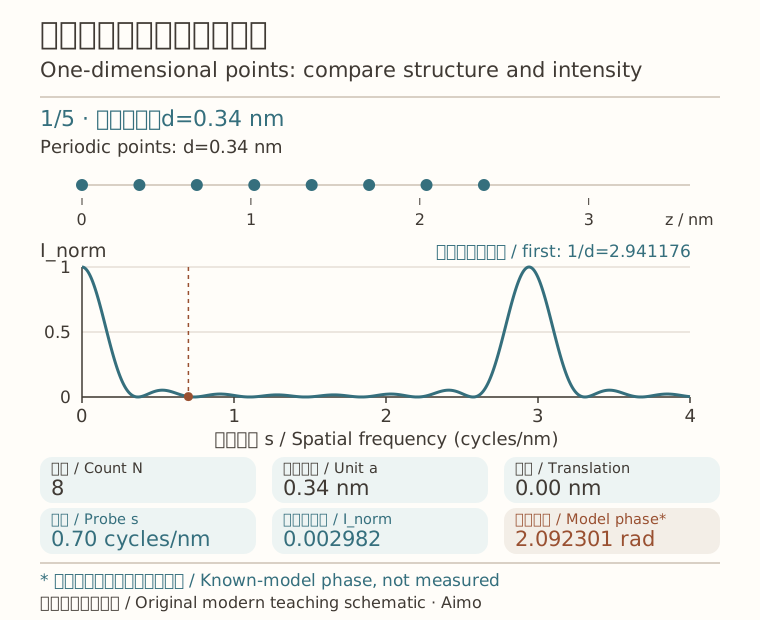
横轴的空间频率s以每纳米的周期数计,不是以弧度计的散射矢量。先让八点等距排列,把间距从0.34改成0.40纳米:第一个非零倒易主峰从约2.941移到2.500周期每纳米,位置恰为间距的倒数。
Spatial frequency s is measured in cycles per nanometre, rather than a scattering vector measured in radians per length. For eight equally spaced points, changing the spacing from 0.34 to 0.40 nm moves the first nonzero reciprocal principal maximum from about 2.941 to 2.500 cycles/nm: the reciprocal of the spacing.
五步比较五种设定,并非时间演化。读数统一在s=0.70周期每纳米处取样,同时列出点数、坐标单位、平移量与强度。相位一栏由已知输入坐标计算,绝不是探测器直接测得的相位。坐标单位在等距情形就是点间距。
The five steps compare five settings, rather than an evolution in time. Readings use a fixed probe at s = 0.70 cycles/nm and list point count, coordinate unit, translation and intensity. The displayed phase is calculated from known input coordinates, not measured directly by a detector. For equally spaced points, the coordinate unit is their spacing.
教学机制示意
Teaching schematic
五种条件:强度保留了什么Five conditions: what does intensity retain?
逐步切换五种独立比较条件:改变周期点距、整体平移,再比较不互为平移或镜像的两组点。每种条件都在s=0.70 cycles/nm读取六个数值;重置回到0.34 nm周期点列。这里的“步”不是经过的时间。
Switch between five comparison conditions: change periodic spacing, translate an array, then compare two sets unrelated by translation or reflection. Every condition reports six readings at s=0.70cycles/nm. Reset returns to the 0.34 nm periodic array. Steps do not represent elapsed time.
周期点列:d=0.34 nmPeriodic points: d=0.34 nm
1 / 5八个点位于z=0.34j nm,j=0…7,a=d=0.34 nm。第一处非零主极大在s=1/d≈2.941176 cycles/nm。固定探针s=0.70 cycles/nm处,I_norm≈0.002982,已知模型计算相位≈2.092301 rad。
Eight points lie at z=0.34j nm, j=0…7, with a=d=0.34 nm. The first nonzero principal maximum is s=1/d≈2.941176 cycles/nm. At the fixed s=0.70 cycles/nm probe, I_norm≈0.002982 and the computed known-model phase is ≈2.092301 rad.
- 散射点数 NScatterer count N
- 坐标单位 aCoordinate unit a
- 整体平移 ΔzTranslation Δz
- 探针空间频率 sProbe spatial frequency s
- 归一化模型强度Normalized model intensity
- 已知模型计算相位(非实测)Computed known-model phase (not measured)
模型边界Model boundary
模型边界:一维、标量、相干、运动学点散射体;每点具有相同的单位实散射振幅。z以nm计,s以cycles/nm计,F(s)=Σexp(2πisz_j),I_norm=|F|²/N²。曲线与读数均由未舍入的复数求和计算;I_norm是归一化模型强度,不是校准胶片计数,也不是有限光束的能量收支。未包含三维纤维几何、原子形状因子、偏振、无序、多重散射或探测器响应;不模拟DNA、螺旋,也不拟合或重建51号照片。五种条件依次为z=0.34j nm、z=0.40j nm、z=0.40j+0.17 nm(j=0…7),以及六点A、B分别乘a=0.20 nm。周期情况a=d;不等距反例中a只是坐标单位。固定探针s=0.70 cycles/nm,显示N、a、平移、s、I_norm与由已知模型计算的相位。后者不是测得的相位;当|F|≤10⁻¹²N时视为数值零振幅,相位返回未定义,五个探针样本都非零。A/B共有15个正点对距离,因此强度对所有s相同;其他化学与几何证据有助于收紧逆问题的可行结构。[4,5,6]
Model boundary: one-dimensional scalar coherent kinematic point scatterers with identical unit real amplitudes. Positions z are in nm, s in cycles/nm, F(s)=Σexp(2πisz_j) and I_norm=|F|²/N². Curves and readings use unrounded complex sums. I_norm is normalized model intensity, not calibrated film counts or a finite-beam energy ledger. The model omits 3D fiber geometry, atomic form factors, polarization, disorder, multiple scattering and detector response. It is not DNA or a helix, and does not fit or reconstruct Photograph 51. Conditions are z=0.34j nm, z=0.40j nm, z=0.40j+0.17 nm (j=0…7), then six-point sets A and B multiplied by a=0.20 nm. For periodic arrays a=d; for the unequal-spacing counterexample a is only a coordinate unit. At s=0.70cycles/nm, six readings show N, a, translation, s, I_norm and computed known-model phase. Phase is not measured; when |F|≤10⁻¹²N it is treated as numerically zero amplitude and phase is undefined. All five probe samples are nonzero. A/B share 15 positive pair distances, so intensity agrees at every s; further chemical and geometric evidence can narrow feasible structures.[4,5,6]
强度相同,排列也相同吗
Does equal intensity mean the same arrangement?
第三种设定把间距0.40纳米的整排点右移0.17纳米。每个波增加同一相位,合振幅随之转动,强度曲线却完全重合。在探针位置,相位增加约0.748弧度。这说明强度本身不能给出模型的绝对位置。
The third setting translates the 0.40 nm array by +0.17 nm. Every wave acquires the same phase shift, rotating their sum while preserving the entire intensity curve. At the probe, the phase increases by about 0.748 rad. Intensity alone therefore cannot locate this model's absolute origin.
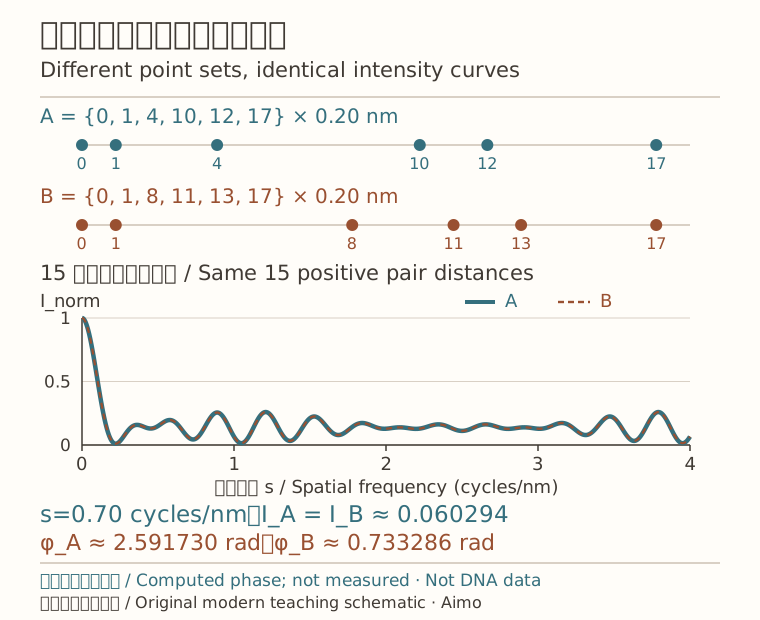
后两种设定更进一步:六点的坐标分别取集合A={0,1,4,10,12,17}和B={0,1,8,11,13,17},都乘0.20纳米。这对经典同距反例不能靠平移或镜像互相重合,排列确实不同。[6]
The last two settings go further: six coordinates are taken from A = {0,1,4,10,12,17} and B = {0,1,8,11,13,17}, each multiplied by 0.20 nm. This classic homometric counterexample cannot be made congruent by translation or reflection: the arrangements really differ. [6]
逐对测量会发现,两组点拥有完全相同的距离清单,包括每个距离出现的次数。展开合振幅模的平方,它只依赖这些成对差值。因此相同的不仅是某个探针读数,而是任意空间频率处的整条强度曲线。[6]
Comparing every pair reveals identical distance lists, including the multiplicity of each distance. Expanding the squared amplitude shows that it depends only on those pairwise differences. Consequently, equality holds at every spatial frequency, across the whole intensity curve, rather than merely at one probe. [6]
在固定探针处,两组归一化强度均约0.060294,已知模型相位却分别约2.592与0.733弧度。不同的相位被强度读数掩盖了。这是明确构造的反演歧义,不能据此声称真实DNA数据也允许这两排点作为答案。
At the fixed probe, both normalized intensities are about 0.060294, while their known-model phases are approximately 2.592 and 0.733 rad. The intensity readings conceal different phases. This deliberately constructed inverse ambiguity does not make these two point arrays alternative solutions to actual DNA data.
证据的边界,也是下一步的起点
The boundary of evidence guides the next step
强度不直接提供相位,是结构分析中的相位问题。它不意味着结构永远不可解,而是提醒我们引入额外测量、合理约束或相位求解方法,并检查假设。增加数据时,也应问新增信息究竟排除了哪些候选结构。[5]
Intensity does not directly supply phase: this is crystallography's phase problem. It does not make structure determination impossible. It calls for additional measurements, justified constraints or phasing methods, together with checks on assumptions. When adding data, ask which candidate structures the new information excludes. [5]
对DNA,化学组成、键的几何、分子尺度和衍射线索必须彼此相容。华生与克里克的模型还提出特定碱基配对及其复制含义;这些内容并不是X形斑纹直接写出的字。可靠解释要让不同来源的证据共同接受检验。[1,3]
For DNA, chemical composition, bond geometry, molecular dimensions and diffraction clues must agree. Watson and Crick's model also proposed specific base pairing and its implications for copying. An X-shaped pattern does not directly encode those conclusions. A reliable interpretation brings evidence from different sources into a shared test. [1,3]
纪念富兰克林与戈斯林,可以从认真阅读一份数据开始:它支持了什么,尚未决定什么,下一次测量该检验什么?一张图的价值,既在它显露的结构线索,也在研究者怎样把线索变成有条件、可核查的科学判断。
One way to honour Franklin and Gosling is to read data carefully: what does it support, what remains undecided, and what should the next measurement test? An image matters both for the structural clues it reveals and for how researchers turn them into conditional, checkable scientific judgments.
参考资料 / References
- R. E. Franklin & R. G. Gosling, Molecular Configuration in Sodium Thymonucleate, Nature 171, 740–741 (1953)原始论文;1953年4月25日发表,A/B形态、B型螺旋证据及结合其他条件进行的结构推断。 / Original paper, published 25 April 1953; A/B forms, evidence for a B-form helix and structural inference using additional constraints.
- Brian Sutton, The story behind Photograph 51, King's College London (14 April 2023)机构历史文章;核对1952年5月、富兰克林与研究生戈斯林、湿度与B型图样,以及照片和其他数据对模型的重要作用。 / Institutional history confirming May 1952, Franklin and graduate student Gosling, humidity and the B-form pattern, and the role of this image together with other data.
- J. D. Watson & F. H. C. Crick, Molecular Structure of Nucleic Acids: A Structure for Deoxyribose Nucleic Acid, Nature 171, 737–738 (1953)原始模型论文,1953年4月25日发表;模型的化学与几何条件、碱基配对和复制含义,不将它们归于单个X形图样。 / Original model paper, published 25 April 1953; chemical and geometric constraints, base pairing and copying implications, not attributed to an X-shaped pattern alone.
- OpenStax, University Physics Volume 3, §4.6 X-Ray Diffraction官方开放教材;散射波干涉、路径差与结构间隔。仅用于衍射物理,历史细节依原论文与机构记录核查。 / Official open textbook on interference of scattered waves, path differences and structural spacings. Used for diffraction physics; historical details are checked against original papers and institutional records.
- International Union of Crystallography, Online Dictionary of Crystallography: Phase problem国际晶体学联合会定义:强度可给出结构因子的模而不直接给出相位;结构确定需相位信息及适当求解方法。 / IUCr definition: intensities provide structure-factor magnitudes but not phases directly; structure determination requires phase information and suitable methods.
- G. S. Bloom, A counterexample to a theorem of S. Piccard, Journal of Combinatorial Theory, Series A 22(3), 378–379 (1977)同距集合的原始反例论文;本文用经典六点A/B配对作原创教学计算,逐项核对距离与任意频率强度等式,不将其作为DNA结构的替代解。 / Original counterexample on homometric sets. The classic six-point A/B pair is used in original teaching calculations, with distances and all-frequency intensity equality independently checked; it is not an alternative DNA structure.