 Aimatra
科学人物 02 / PEOPLE IN SCIENCE 02
磁铁为什么能发电?——法拉第与变化中的磁场
How Can a Magnet Generate Electricity? — Faraday and Changing Magnetic Fields
从1831年的短暂偏转,到一笔不能漏算的能量账From a brief deflection in 1831 to an energy balance we cannot skip
从装订书页到实验台
From bookbinding to the laboratory
把磁铁放在线圈旁,灯泡就会一直亮吗?很多人会猜:磁铁越强,电就越多。可在这个固定线圈的实验里,磁铁一旦停住,发电的作用便消失。要理解这件事,可以跟着法拉第,把注意力从“有什么”转向“什么正在改变”。
Will a lamp keep glowing if we simply place a magnet beside a coil? A tempting guess is that a stronger magnet means more electricity. Yet in this experiment with a fixed coil, the generating action disappears when the magnet stops. Following Faraday means shifting our attention from what is present to what is changing.
迈克尔·法拉第生于1791年,父亲是一名铁匠。他先做装订学徒,1813年进入英国皇家研究院当实验室助手,后来长期在那里研究与讲学。从书页走到实验台,这条路提醒我们:科学能力既需要阅读,也需要亲手检验。[1]
Michael Faraday was born in 1791, the son of a blacksmith. He trained as a bookbinder before becoming a laboratory assistant at the Royal Institution in 1813, where he later spent many years researching and lecturing. His path from books to the laboratory reminds us that scientific understanding grows through both reading and practical investigation. [1]
我们今天记住他的名字,不只是因为一条定律。更值得追随的是一种提问方式:既然电流能产生磁的作用,磁的作用能否反过来产生电?而当装置没有给出预期的持续电流时,那一下短暂的偏转,又在告诉人什么?[2,4]
We remember him for more than a law. His way of asking questions is also worth following: if an electric current produces magnetic effects, could magnetism produce electricity in return? And when an apparatus failed to produce the expected continuous current, what could a brief deflection be telling the experimenter? [2,4]
指针为什么只动一下
Why did the needle move only briefly?
1831年8月29日,法拉第用铁环和两组彼此绝缘的线圈取得突破。一组接电池,另一组接检流计,仪器用指针显示是否有电流。两组导线没有直接接通,电池中的电流并不是沿着金属导线“漏”到另一边。[2,4]
On 29 August 1831, Faraday made a breakthrough with an iron ring carrying two insulated sets of windings. One was connected to a battery and the other to a galvanometer, whose needle detected current. The wires of the two circuits were not directly connected: battery current was not simply leaking through a metal connection into the second circuit. [2,4]
接通电池时,另一边的指针短暂偏转;电流稳定后,指针回到原处。断开电池时,指针又向相反方向偏转。决定性的线索藏在开关动作的前后:不是只要第一组线圈通电,第二组就始终有电流。[4]
When the battery connection was made, the other circuit showed a brief deflection. Once the current settled, the needle returned. Breaking the battery connection produced a deflection in the opposite direction. The crucial clue lay in what happened around these switching events: current in the first winding did not maintain a continuous current in the second. [4]
这里变化的是铁环中的磁场。通电之初,磁场建立;断电之际,磁场减弱。这套装置由电池供能,可看作变压器的早期形式;它与下文手推磁铁的能量来源不同,也不能和“把条形磁铁插入线圈”画成同一次实验。[2,4]
What changed was the magnetic field in the iron ring. The field built up when the current began and weakened when it ended. Powered by a battery, this device was an early form of transformer. Its energy source differs from the hand-driven magnet below, and it should not be presented as the same experiment as inserting a bar magnet into a coil. [2,4]
皇家研究院另存有一套标为1831年10月的装置:条形磁铁在线圈中进出,线圈保持不动,检流计随之响应。它把“改变磁场”这件事变得更容易看见:这次不用开关电池,只需移动磁铁。[3]
The Royal Institution preserves another apparatus dated October 1831. A bar magnet moved into and out of a stationary coil, producing a galvanometer response. This makes the changing magnetic situation easier to see: instead of switching a battery, the experimenter moves a magnet. [3]
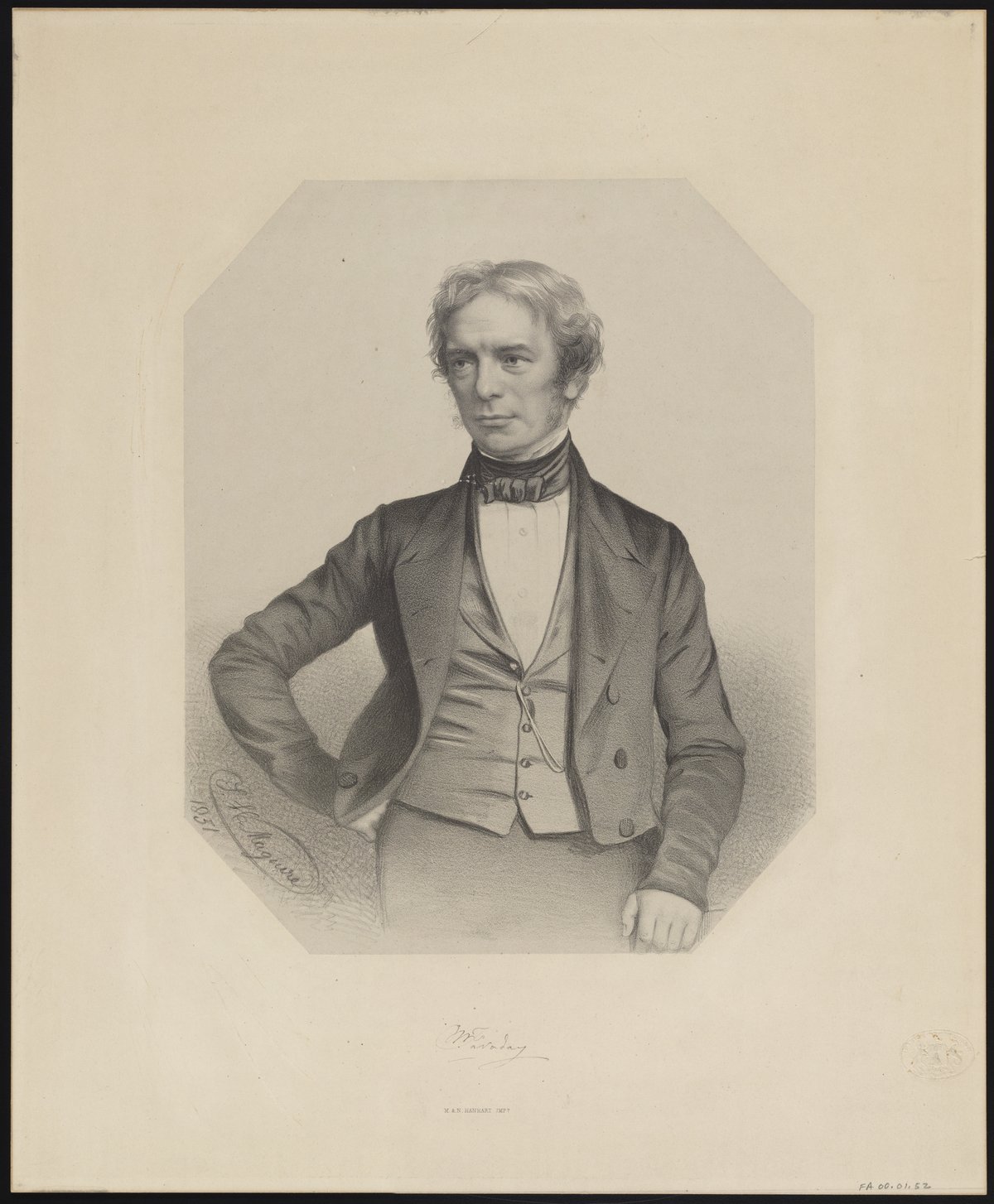
迈克尔·法拉第Michael Faraday · 1791–1867肖像作于 1851 年 / Portrait: 1851
1831.08.29 · 感应环 / Induction ring
- A · 电池与开关
- Cell and switch
- B · 检流计
- Galvanometer
开关接通或断开时,另一电路短暂响应。Making or breaking the first circuit produces a transient response in the other.
装置依据 / Apparatus source: Royal Institution · 示意重绘 / Schematic: Aimo.
关键是穿过线圈的磁通量
What matters is the magnetic flux through the coil
怎样描述线圈感受到的变化?现代物理用“磁通量”衡量磁场穿过某个面的情况,它同时取决于磁场、面积和朝向。画出的磁力线帮助我们想象分布,却不是能一根根收进铜线、变成电流的细丝。[5]
How do we describe the change experienced by a coil? Modern physics uses magnetic flux to measure the magnetic field passing through a surface. It depends on the field, the surface area and its orientation. Drawn field lines help us visualize that distribution; they are not threads that can be collected into copper wire and turned into current. [5]
先把线圈固定,让磁铁的北极朝它靠近:穿过线圈的磁通量改变,便产生感应电动势。这个名称虽然带“力”字,单位却是伏特,描述的是驱动电荷沿回路运动的作用,并不是以牛顿计量的机械力。[5]
Keep the coil fixed and move the magnet's north pole towards it. The changing flux induces an electromotive force, or emf. Despite its name, emf is measured in volts rather than newtons. It describes the electrical action that can drive charges around a circuit, rather than a mechanical force. [5]
电动势和电流还要分清。接成闭合回路,才会出现这里演示的环流;把导线断开,即使仍有感应电动势,也没有沿这个回路持续流动的电流。图中的指针为教学示意,采用忽略自感与仪表惯性的电阻回路近似。[4,5]
Emf and current must also be distinguished. The circulating current shown here requires a closed circuit. If the wire is disconnected, an induced emf can still exist without a sustained current around that circuit. The illustrated needle is a teaching aid using a resistive-circuit approximation that neglects self-inductance and instrument inertia. [4,5]
现在停住磁铁。在这个线圈固定、外部磁场也不再变化的设置中,磁通量保持不变,感应电动势为零。把磁铁沿原路拉回,变化方向反转,电动势随之反号;沿相同轨迹在相同位置移动得更快,电动势的绝对值通常更大。[5]
Now stop the magnet. With the coil fixed and the external magnetic field no longer changing, the flux stays constant and the induced emf is zero. Pull the magnet back along the same path and the emf changes sign. At the same position on the same path, faster motion generally produces an emf of greater magnitude. [5]
教学机制示意
Teaching schematic
靠近、停住、移开:观察指针Approach, hold, withdraw: watch the needle
每一幅表示一个区间内的代表状态,步骤不是等时间隔的连续快照;线圈固定,N 极始终朝右。
Each frame represents a condition during an interval, not equally spaced snapshots of continuous motion. The coil stays fixed and the N pole always faces right.
蓝虚线:外磁场向右;棕箭头:感应磁场。正法向任取为向右,正电流由右手规则约定;电流计的正负只表示这个固定约定。
Blue dashed arrow: external field to the right. Brown arrow: induced field. The positive normal is chosen rightward, with positive current set by the right-hand rule; the meter’s signs follow this fixed convention.
远处静止At rest, farther away
1 / 5磁铁和闭合线圈都不动。线圈已有正向磁通量,但磁通量不随时间改变:感应电动势和电流为零。
The magnet and closed coil are at rest. Positive magnetic flux already passes through the coil, but it is not changing with time: induced emf and current are zero.
ε = −N dΦ/dtI ≈ ε/R
本示意用 Φ(d)=1/(1+d²),d 为间距;接近时 dd/dt<0。读数均为相对教学单位,归一化取 N=R=1,并非真实磁铁的场分布或仪表刻度。
This schematic uses Φ(d)=1/(1+d²), where d is separation and dd/dt<0 means approach. All readings are in relative teaching units, with normalized N=R=1; they are not a real magnet’s field profile or an instrument calibration.
采用低自感、以电阻为主的准静态近似,忽略线圈自感和仪表惯性。真实线圈停下后可能仍有短暂衰减电流;这里不模拟这一过渡过程。
A low-inductance, resistance-dominated quasistatic approximation neglects coil self-inductance and meter inertia. A real coil may retain a briefly decaying current after motion stops; that transient is outside this model.
磁铁不是被消耗的燃料
The magnet is not a fuel being used up
如果反复推拉就能发电,能量从哪里来?闭合线圈中的感应电流也会产生磁场。它的作用趋向于阻碍引起感应的磁通量变化:靠近时妨碍靠近,离开时妨碍离开。这是楞次定律所概括的方向关系。[6]
If repeated pushing and pulling generates electricity, where does the energy come from? The induced current in the closed coil produces its own magnetic field. Its effect opposes the flux change responsible for induction: it resists approach during approach and withdrawal during withdrawal. Lenz's law summarizes this direction rule. [6]
因此,要按原定速度继续移动磁铁,手就需要对抗电磁阻力做功。在这里的电阻负载模型中,输入的机械能通过电磁过程转移到回路,最终成为焦耳热。磁铁提供磁场条件,不是在每次发电时燃烧一小份“磁性”。[6]
To keep moving the magnet at the chosen speed, the hand must therefore do work against electromagnetic resistance. In the resistive-load model used here, mechanical energy is transferred through the electromagnetic interaction into the circuit and ultimately becomes Joule heat. The magnet provides the magnetic conditions; each generating stroke does not burn up a portion of its magnetism. [6]
若不再用手维持运动,电磁作用可以使物体的动能减少。真实装置还会暂存磁场能量,并有摩擦损耗。对无额外损耗的完整往返,当初末同位、静止且磁场储能相同时,手做的净功就等于回路产生的热;不能把任意瞬间都画成机械功立即全部变热。[6]
Without a hand maintaining the motion, electromagnetic interaction can reduce an object's kinetic energy. Real devices can also store magnetic-field energy temporarily and lose energy through friction. For a complete return stroke without additional losses, the hand's net work equals the heat produced in the circuit when the endpoints have the same position, zero speed and the same stored magnetic energy. Mechanical work should not be depicted as becoming heat immediately and entirely at every instant. [6]
完整往返的能量账本 / Energy over a complete round trip
手或外部驱动
Hand or external drive
克服电磁阻力做功Work against electromagnetic drag电路中的能量传递
Electrical energy transfer
感应电动势驱动电流Induced emf drives a current电阻发热
Joule heating
能量转为内能Energy becomes internal energy
回到同一位置,起止都静止,电磁暂态已消退。
Same start and end position, both at rest, with electromagnetic transients settled.
让问题继续走下去
Keeping the questions alive
大型发电机把短促的推拉改成持续转动,让线圈与磁场的相对关系周期变化。推动转轴的可以是水、风或蒸汽;电磁感应连接着机械输入与电能输出。不同设备的结构各异,能量有来处这一点相同。[3]
Large generators replace brief strokes with continuous rotation, periodically changing the relationship between coils and magnetic fields. Water, wind or steam can drive the shaft; electromagnetic induction links the mechanical input to the electrical output. Devices differ in construction, but their energy must always come from somewhere. [3]
今天教材里的磁通量公式和方向规则,是用现代语言组织起来的知识。法拉第留下的实验与论证推动了这条道路,后来的理论发展使它更加完整。阅读原始论文,能看到他如何逐项比较接通、断开、靠近与远离,而不只看到结论。[4,5,6]
Today's flux equations and direction rules organize this knowledge in modern language. Faraday's experiments and arguments helped establish the path, and subsequent theoretical developments made the account more complete. Reading his original paper reveals comparisons between connection and disconnection, approach and withdrawal, rather than only a finished conclusion. [4,5,6]
他也把实验带进公众讲堂。想继续认识他,可以读《电学实验研究》,追踪证据如何积累;也可以读《蜡烛的化学史》,看熟悉的事物怎样打开新问题。后者由威廉·克鲁克斯编辑,于1861年出版,是讲座整理本。[1,4]
Faraday also brought experiments into public lectures. To get to know his work further, read Experimental Researches in Electricity and follow the accumulation of evidence, or The Chemical History of a Candle and see how familiar objects open new questions. The latter was edited by William Crookes and published in 1861 as a collection of lectures. [1,4]
看完分步互动,不妨再问一次:磁铁还在那里,为什么指针不动?能解释“没有发生什么”,也就更接近理解发生了什么。纪念一位实验者,可以从保留这种耐心开始:让装置给出答案,也让反常之处改变自己的猜想。
After the step-by-step demonstration, ask again: if the magnet is still there, why is the needle still? Explaining why something does not happen brings us closer to understanding what does. One way to honor an experimenter is to keep that patience: let the apparatus answer, and let an unexpected result change the guess.
参考资料 / References
- Royal Institution. Michael Faraday (1791–1867).人物生平与出版物目录;《蜡烛的化学史》由 William Crookes 编辑,1861年出版。Biography and publications; the 1861 Chemical History of a Candle was edited by William Crookes.
- Royal Institution. Michael Faraday’s ring-coil apparatus.1831年8月29日的感应环:两组绝缘线圈与短暂感应电流。The induction ring of 29 August 1831: insulated windings and transient induction.
- Royal Institution. Michael Faraday’s generator.藏品标注为1831年10月;磁铁相对固定线圈运动的装置。Collection date: October 1831; a magnet moving relative to a stationary coil.
- Faraday, M. Experimental researches in electricity (First Series). Philosophical Transactions of the Royal Society of London 122, 125–162 (1832).DOI: 10.1098/rstl.1832.0006。1831年11月24日宣读;链接为《电学实验研究》第1卷1849年第二版的公开转录,见 First Series,尤其 §§10–19、27–40、54–59。Read on 24 November 1831; linked transcription from the 1849 second edition of Volume I, First Series.原刊 DOI / Original paper DOI
- OpenStax. University Physics Volume 2, §13.1: Faraday’s Law.磁通量、感应电动势及固定线圈中移动磁铁的比较。Magnetic flux, induced emf and a moving magnet with a fixed coil.
- OpenStax. University Physics Volume 2, §13.2: Lenz’s Law.感应方向与能量守恒。Direction of induction and conservation of energy.