 Aimatra
科学人物 08 / PEOPLE IN SCIENCE 08
光更亮,电子就一定跑得更快吗?——爱因斯坦与光电效应
Does Brighter Light Always Make Electrons Faster? — Einstein and the Photoelectric Effect
把光强、频率与电子的能量分开,读懂一道改变光观念的门槛Separate intensity, frequency and electron energy to understand a threshold that changed our picture of light
更大的电流,不一定是更快的电子
A larger current need not mean faster electrons
把灯调亮,照到桌面的能量通常更多。若光能把材料里的电子打出来,直觉便说:光越亮,电子跑得越快。光电效应却要求拆开两个问题:单位时间出来多少电子,以及最快的电子带走多少能量。[1,3]
Turning up a lamp usually sends more energy onto a desk. If light can eject electrons from a material, it is tempting to expect brighter light to make them faster. The photoelectric effect requires two separate questions: how many electrons emerge per unit time, and how much energy the fastest ones carry. [1,3]
在一种典型装置中,单色光照射真空里的发射电极,另一电极收集逸出的电子,电流表记录电荷流动。真空减少电子与空气分子的碰撞。电流大小反映被收集的电子流量,不能直接当成电子速度表。[3]
In a typical apparatus, monochromatic light illuminates an emitting electrode in vacuum while another electrode collects escaping electrons. An ammeter records charge flow. Vacuum reduces collisions with air molecules. Current indicates the collected electron flow, rather than directly measuring electron speed. [3]
弱光实验呈现几条相互关联的线索:频率太低,照亮也不发射;超过门槛,较弱的光也能迅速产生发射;同频率下增加光强,最大动能却不随之增加。把电子想成慢慢蓄满连续波能量的小桶,很难同时解释这些事实。[1,3]
Weak-light experiments give linked clues: light below a threshold frequency produces no emission; above it, even dim light can produce prompt emission; increasing intensity at fixed frequency leaves the maximum kinetic energy unchanged. An electron imagined as a bucket slowly accumulating continuous wave energy struggles to explain these observations together. [1,3]
1905年,把光的能量分成一份份
In 1905, considering light energy in separate portions
1905年,爱因斯坦发表关于光的产生与转化的启发式论文。他没有宣称首次发现光电效应,而是追问:若光的能量交换具有一份份的结构,已有观察会不会更容易理解?论文把设想写成能够接受实验检验的关系。[1]
In 1905, Einstein published a heuristic paper on the production and transformation of light. He did not claim to have discovered the photoelectric effect. He asked whether existing observations became more intelligible if light exchanged energy in separate portions, and developed relations that experiments could test. [1]
用今天的记号,一份光量子的能量为E=hf,h是普朗克常数,f是频率。同色光更亮,可以增加到达的光量子数,却不改变每份的hf。1905年的光量子设想,是后来光子概念的起点,不能把完整现代理论倒写进原文。[1,3]
In modern notation, a light quantum carries E = hf, where h is Planck's constant and f is frequency. Brighter light of the same colour can deliver more quanta without changing hf per quantum. The 1905 proposal was an important starting point for the later photon concept, rather than the complete modern theory. [1,3]
这没有抹掉光的波动证据。论文承认波动理论解释光学现象的成功,再指出光的产生和转化可能暴露连续描述的局限。干涉、衍射与光电发射提出不同的实验问题;接受新的能量交换规律,不等于宣布旧观察作废。[1]
This did not erase evidence for light's wave behaviour. The paper acknowledged wave theory's optical successes before questioning a continuous description of light production and transformation. Interference, diffraction and photoemission pose different experimental questions; a new energy-exchange rule does not invalidate earlier observations. [1]
对单光子发射,电子离开表面需要付出最低能量φ,称为逸出功。若吸收的一份hf足够,能量还可留给逸出电子。在最大动能的边界上,账本写作hf=φ+Kmax;若hf小于φ,便没有这一通道可供逸出。[1,3]
In single-photon emission, escaping the surface requires a minimum energy φ, the work function. If the absorbed hf suffices, energy can remain as electron motion. At the maximum-energy boundary, the ledger is hf = φ + Kmax. When hf is below φ, this emission channel is unavailable. [1,3]
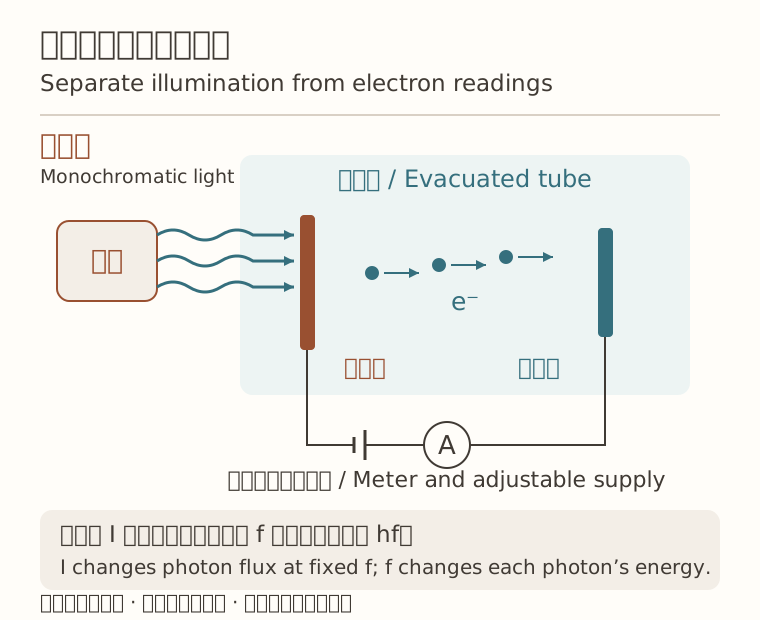
怎样测出能量的上边界
Measuring the upper energy boundary
Kmax中的最大二字不可省略。电子的初始状态、到达表面的路径和能量损失不同,逸出后可有一段能量分布。方程指定分布的上边界,不保证每个电子都得到hf−φ,更不能把所有电子画成具有同一速度。[1,4]
The maximum in Kmax matters. Electrons can differ in initial state, path to the surface and energy loss, producing an energy distribution. The equation specifies its upper boundary; it does not give every electron hf − φ or assign all emitted electrons the same speed. [1,4]
把收集电极的电势反向调节,电子便需克服电场阻力。直到最快的电子也无法抵达,电流截止,对应遏止电压的大小Us,满足eUs=Kmax。电子数量影响电流,能量上限则由另一种读数辨认。[3,4]
Reversing the collecting voltage makes escaping electrons climb an electrical barrier. When even the fastest cannot reach the collector, the current stops. The stopping-voltage magnitude Us satisfies eUs = Kmax. Electron number affects current, while a different measurement identifies the energy limit. [3,4]
1916年,密立根发表光电法测定普朗克常数的论文,精密检验爱因斯坦关系。改变频率,再比较遏止电压,可以检查直线关系及其斜率。大胆设想于是交给了可重复的测量,每项数值预言都可以被检查。[4]
In 1916, Millikan published a direct photoelectric determination of Planck's constant, carefully testing Einstein's relation. Varying frequency and comparing stopping voltages tested the predicted line and its slope. Repeatable measurements thus put the bold proposal and its numerical predictions to the test. [4]
爱因斯坦的1921年度诺贝尔物理学奖,特别表彰他发现光电效应定律的贡献;保留的奖项于1922年授予。相对论的名声容易遮住这条线索:关于光与电子的能量账本,也能改变人们理解自然的方式。[2]
Einstein's Nobel Prize in Physics for 1921 especially recognised his discovery of the law of the photoelectric effect. The reserved prize was awarded in 1922. His association with relativity can obscure this other achievement: an energy ledger for light and electrons also changed how nature was understood. [2]
教学机制示意
Teaching schematic
五步对照:更亮、能量与数量Five comparisons: brightness, energy and number
依次改变频率或辐照度,比较每个光子的能量、最大动能和通量;重置返回第一个条件。五步是独立的条件对照,不是连续时间轨迹。请特别比较第1–2步、第3–4步,以及固定辐照度的第4–5步。
Change frequency or irradiance to compare photon energy, maximum kinetic energy and number flux; Reset returns to the first condition. These are separate comparison conditions, not a time trajectory. Compare steps 1–2, 3–4 and the fixed-irradiance pair 4–5.
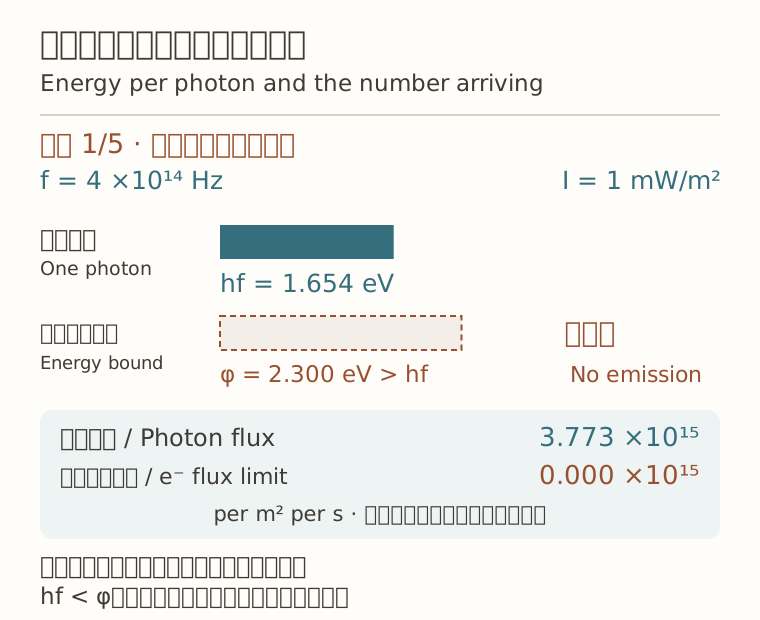
阈值以下:较弱辐照Below threshold: lower irradiance
1 / 5f=4×10¹⁴ Hz 时,每个光子约有1.654 eV,低于假想材料的2.30 eV逸出功。I=1 mW/m²时,光子通量约3.773×10¹⁵/(m²·s),但单光子不能让电子逸出;最大动能读数显示“无发射”,不显示负的物理动能。未计算的反射或加热不等于能量消失。
At f=4×10¹⁴ Hz each photon carries about 1.654 eV, below the hypothetical 2.30 eV work function. With I=1 mW/m² the photon flux is about 3.773×10¹⁵/(m²·s), but there is no one-photon emission. The kinetic-energy reading says “No emission” rather than assigning a negative physical kinetic energy. Unmodelled reflection or heating does not mean energy disappears.
- 频率 fFrequency f
- 辐照度 IIrradiance I
- 单光子能量 hfPhoton energy hf
- 最大动能 KmaxMaximum kinetic energy Kmax
- 入射光子通量Incident photon flux
- 电子通量理想上限(非材料预测)Ideal electron-flux upper limit (not a material prediction)
模型边界Model boundary
模型边界:单色光、单光子弱场近似,假想材料逸出功φ=2.30 eV,不对应命名真实金属或历史数据。精确SI常数h=6.62607015×10⁻³⁴ J·s,1 eV=1.602176634×10⁻¹⁹ J;f₀=φe/h≈5.5613752568×10¹⁴ Hz。hf>φ时Kmax=hf−φ是逸出瞬间的最大动能,满足φ+Kmax=hf;并非全部光子能量都变为动能,也并非每个光电子都具有Kmax。hf<φ时无单光子发射,不赋予负动能;f=f₀是Kmax=0的临界边界,不估计可收集电子通量。光子通量=I/(hf),I由mW/m²乘10⁻³换为W/m²。仅在阈值以上,假设一光子至多产生一个电子、单位量子产额、零反射且完全收集,电子通量理想上限才等于入射光子通量,非实际材料预测。五组(f/Hz,I/(mW/m²))为(4×10¹⁴,1)、(4×10¹⁴,3)、(7×10¹⁴,1)、(7×10¹⁴,3)、(1×10¹⁵,3)。未模拟时间延迟、多光子过程、加热、反射、量子效率变化或饱和与收集动力学;阈值以下能量仍可反射或转为热,不是消失。中间计算不取整,显示值才四舍五入。[1,3,5]
Model: monochromatic light in the weak-field one-photon limit, with a hypothetical work function φ=2.30 eV, no named real metal or historical dataset. Exact SI values are h=6.62607015×10⁻³⁴ J·s and 1 eV=1.602176634×10⁻¹⁹ J; f₀≈5.5613752568×10¹⁴ Hz. Above threshold, Kmax=hf−φ is the kinetic-energy upper bound at escape, with φ+Kmax=hf. Escape requires energy and individual photoelectrons need not reach this bound. Below threshold there is no one-photon emission or negative kinetic energy; exact threshold is the marginal Kmax=0 boundary with no collected-flux estimate. Photon flux is I/(hf) after multiplying mW/m² by 10⁻³. Only above threshold does the ideal electron-flux upper limit equal incident photon flux under at most one electron per incident photon, unit quantum yield, zero reflection and complete collection. This is no actual material prediction. The five (Hz, mW/m²) conditions are (4×10¹⁴,1), (4×10¹⁴,3), (7×10¹⁴,1), (7×10¹⁴,3), (1×10¹⁵,3). No time delay, multiphoton process, heating, reflection, varying quantum efficiency, saturation or collection dynamics are simulated. Below-threshold energy can be reflected or become heat. Only displayed values are rounded.[1,3,5]
同一块假想材料,分开转动两个旋钮
Turning two controls separately on one hypothetical material
下方把假想材料的逸出功设为2.30eV,不指定金属表面。用现代SI精确定义的h和基本电荷e换算,门槛f₀=φ/h约为5.56×10¹⁴Hz;φ须与h使用相容单位,不能直接把电子伏特除以焦耳秒。[5]
The example sets a hypothetical work function of 2.30 eV, without identifying a metal surface. Converting with the exact modern SI values of h and elementary charge e gives f₀ = φ/h ≈ 5.56 × 10¹⁴ Hz. Compatible units are essential: electronvolts cannot simply be divided by joule seconds. [5]
先固定频率4×10¹⁴Hz,单光子能量约1.654eV,仍低于门槛。把辐照度从1增到3mW/m²,只是让不够付逸出功的光子来得更多。在这个弱场单光子模型里,两种条件都没有光电子发射,不能靠数量替单份补差额。
At 4 × 10¹⁴ Hz, each photon carries about 1.654 eV, below threshold. Raising irradiance from 1 to 3 mW/m² supplies more photons that each lack the required energy. In this weak-field single-photon model, neither condition emits photoelectrons; increasing their number does not fill the per-photon deficit.
改为7×10¹⁴Hz,每份约2.895eV,最大动能约0.595eV。辐照度从1调到3mW/m²,入射光子流量增为三倍,最大动能保持原值。更多电子有机会出来,与最快者能够多快,是两件可以分别操纵的事。
At 7 × 10¹⁴ Hz, each photon carries about 2.895 eV and Kmax is about 0.595 eV. Increasing irradiance from 1 to 3 mW/m² triples the incident photon flux while leaving Kmax unchanged. The number of emission opportunities and the fastest possible electron are separate controls.
保持3mW/m²,升到10¹⁵Hz:每份约4.136eV,最大动能升至1.836eV。但同样功率要分给更贵的光子,光子流量I/(hf)反而下降。提高频率能够抬高能量上限,并不自动意味着电子更多。
Keeping 3 mW/m² but raising frequency to 10¹⁵ Hz gives about 4.136 eV per photon and Kmax ≈ 1.836 eV. The same incident power now pays for more energetic photons, so photon flux I/(hf) decreases. A higher energy ceiling does not automatically mean more emitted electrons.
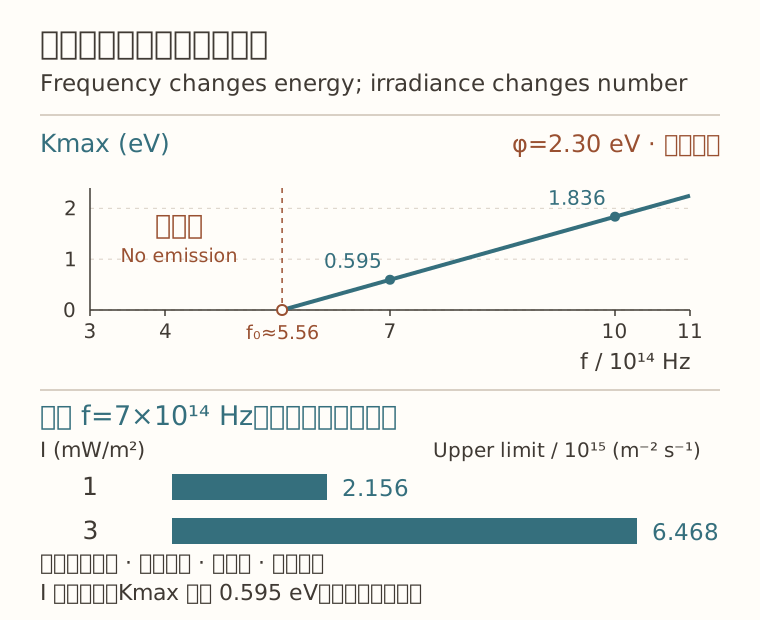
亮度之外,还要问每份能量
Beyond brightness, ask about energy per quantum
图中电子流量是假定门槛以上每个入射光子都贡献一个逸出电子的理想上限。它省略反射、内部输运、收集效率与饱和,也未模拟延迟和本底,不是材料产率预报。五组条件是控制变量的比较,并非时间演化轨迹。
The illustrated electron flux is an ideal upper limit assuming one emitted electron per incident photon above threshold. Reflection, internal transport, collection efficiency, saturation, delay and background are omitted. This is no material-yield prediction. The five conditions compare controls rather than trace a time evolution.
没有光电子,不等于光能消失。门槛以下的光仍可能反射,或通过其他吸收过程转成热;这些渠道未画进模型。φ+Kmax只核算最大能量电子的发射通道,不能冒充整套装置所有入射、输出与损耗的总账。
No photoelectrons does not mean lost energy. Below-threshold light may be reflected or absorbed through other processes and converted to heat; those channels are absent here. The φ + Kmax balance concerns the maximum-energy emission channel, rather than the complete apparatus's inputs, outputs and losses.
因此,光更亮并不保证电子更快。这个回答适用于这里的弱场单光子条件;强场多光子过程和热发射不在讨论范围,不能推广到所有激光实验。爱因斯坦留下的追问仍然清楚:比较的是总能流、光子数,还是一次交换的能量?[1,3]
Brighter light therefore need not make electrons faster within these weak-field, single-photon conditions. Strong-field multiphoton processes and thermal emission are outside this model, so the result cannot cover every laser experiment. The question remains precise: are we comparing total energy flow, photon number or energy per exchange? [1,3]
参考资料 / References
- A. Einstein · Über einen die Erzeugung und Verwandlung des Lichtes betreffenden heuristischen Gesichtspunkt · Annalen der Physik 322, 132–148 (1905)1905年原始论文;出版社原始扫描已核验。开头承认波动光学的成功,第8节讨论光量子、逸出所需能量、最大动能、遏止电势与频率关系,以及同频率光强对电子数而非速度分布的影响。本文采用现代h、f、φ记号,不把后来完整光子理论或名称倒置归于1905年。
- NobelPrize.org · The Nobel Prize in Physics 1921诺贝尔官方奖项概要:爱因斯坦的1921年度奖表彰理论物理贡献,尤其光电效应定律;该保留奖项于1922年授予。不把相对论写成此次授奖理由。
- OpenStax · University Physics Volume 3 · §6.2 Photoelectric Effect官方开放教材:真空光电装置、光电流、遏止电压、阈频、光强与最大动能的区别、E=hf与Kmax=hf−φ。本文对弱场单光子适用范围、真实能量分布、效率及未建模渠道作明确限定;不采用教材简化叙述中每个入射光子必然发射的表述作为真实材料定律。
- R. A. Millikan · A Direct Photoelectric Determination of Planck's h · Physical Review 7, 355–388 (1916)原始实验论文;APS出版社核验1916年3月1日发表,原始PDF相关章节已读,Caltech作者库交叉核验版本与页码。研究通过频率、光电势和接触电势等控制检验爱因斯坦关系并测定h;不把1916年出版日期误写成所有实验首次开始的日期。
- NIST · Meet the Constants · Planck constant and elementary charge现代SI常数:h=6.62607015×10⁻³⁴J·s,e=1.602176634×10⁻¹⁹C,均为精确定义值。电子伏特通过e换算成焦耳。假想逸出功2.30eV、五组控制条件及数值由本文计算,并非NIST给出的材料参数或历史测量。