 Aimatra
科学人物 07 / PEOPLE IN SCIENCE 07
放射性为什么不听普通化学反应的指挥?——居里与原子内部的线索
Why Does Radioactivity Resist Ordinary Chemical Control? — Curie and Clues within the Atom
从矿石中偏高的读数,走向元素性质、半衰期与计数中的概率From unexpectedly active minerals to elemental properties, half-lives and the probability behind counts
换一种化合物,射线还在
Change the compound, and the rays remain
糖受热会变色,酸碱相遇会改变溶液,许多化学反应能靠条件调节。把含铀物质变成不同化合物,看不见的射线为什么仍然出现?问题不在物质有没有反应,而在射线的来源藏在哪一层。[2,5]
Sugar changes colour when heated, and mixing acids and bases changes a solution; conditions can control many chemical reactions. Radioactivity poses another question: why do invisible rays persist when uranium-bearing material is converted into different compounds? The issue is which level of the material supplies the radiation. [2,5]
1896年,亨利·贝克勒尔发现铀的自发辐射。玛丽·居里随后系统研究,用射线使空气导电的效应测量活性:在两块金属板之间施加电压,比较微弱电流。隐约的底片痕迹,变成了能够反复比较的读数。[1,2]
In 1896, Henri Becquerel discovered spontaneous radiation from uranium. Marie Curie then undertook systematic research, measuring activity through the rays' ability to make air conductive: a voltage between two metal plates allowed weak currents to be compared. Faint photographic traces thus became readings that could be repeatedly compared. [1,2]
她比较铀的不同化合物,发现活性主要随铀含量变化,并不随外观和普通化学性质一起改头换面。这支持一个判断:发射射线是铀元素的原子性质,而非某种分子排列独有的效果。这里还不是完整的现代原子核解释。[2,3]
Comparing uranium compounds, she found that activity primarily followed their uranium content rather than their appearance or ordinary chemical properties. This supported a crucial inference: emitting the rays was an atomic property of uranium, rather than an effect unique to a molecular arrangement. This was not yet a complete modern nuclear explanation. [2,3]
矿石里多出来的活性
The activity left unexplained in an ore
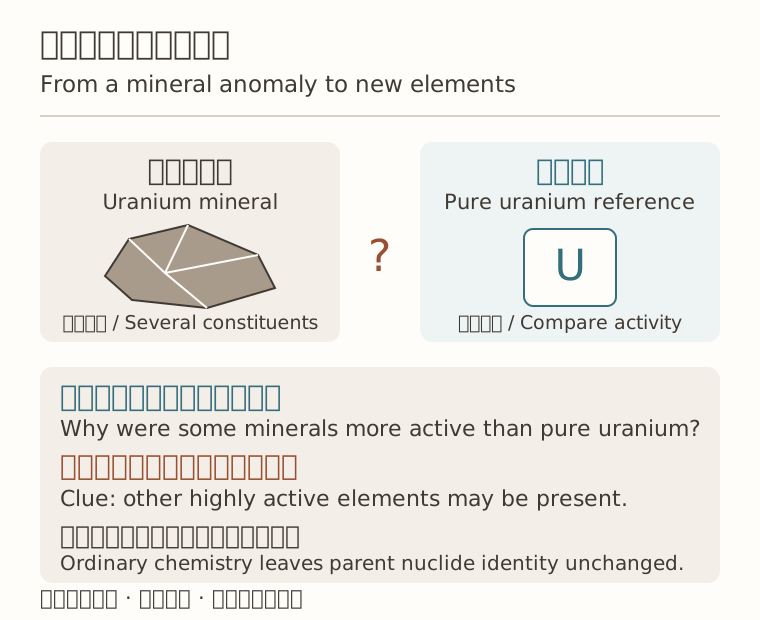
接着出现了更有力的异常:有些天然沥青铀矿的活性,比其中的铀能够解释的还强。若只是把铀与不活泼的杂质混在一起,为什么反而更活跃?居里提出,矿石可能含有极少量尚未识别、却格外活跃的物质。[2,3]
A stronger anomaly followed: some natural pitchblende was more active than its uranium content could explain. Why would mixing uranium with inactive impurities make it more active? Curie proposed that the ore might contain a tiny amount of an unidentified, exceptionally active material. [2,3]
寻找它需要化学与电学接力。研究者把矿石分成不同组分,每分离一步就测一次活性,看异常读数跟着哪部分走。化学反应负责搬运和富集物质;读数追踪的性质,却没有因此被普通反应消除。[3,4]
Finding it required chemistry and electrical measurement to work together. The researchers separated the ore into fractions and measured activity after each step, following the fraction with the anomalous reading. Chemical reactions moved and concentrated the material, while its tracked property survived ordinary chemical processing. [3,4]
1898年7月18日,玛丽与皮埃尔·居里报告随铋组分富集的活性物质,提出钋的名称,纪念玛丽的祖国波兰。论文仍保留条件:如果新金属的存在得到证实,才采用这一名称。发现的起点,是需要检验的元素假说。[3]
On 18 July 1898, Marie and Pierre Curie reported an active material concentrated with the bismuth fraction and proposed polonium, after Marie's homeland, Poland. Their paper retained a condition: the name was proposed if the new metal's existence was confirmed. The discovery began as an elemental hypothesis requiring further tests. [3]
同年12月26日,玛丽、皮埃尔与古斯塔夫·贝蒙共同报告随钡组分富集的另一种活性物质,提出镭的名称。化学行为相似,不等于就是钡;异常活性与光谱提示另有成分。后来纯镭盐的制备和原子量测定,进一步确立了它的元素身份。[2,4]
On 26 December that year, Marie, Pierre and Gustave Bémont jointly reported another active material concentrated with barium and proposed radium. Similar chemical behaviour did not make it barium: anomalous activity and spectral evidence indicated another component. Preparing pure radium salts and determining its atomic weight later established its elemental identity more firmly. [2,4]
把化学层次与核层次分开
Distinguishing the chemical and nuclear levels
1903年,贝克勒尔与皮埃尔、玛丽·居里共享诺贝尔物理学奖;1911年,玛丽独自获得化学奖。两奖指向相关而不同的工作:研究自发辐射,以及发现和研究新的放射性元素。最初发现放射性的功劳仍归贝克勒尔。[1,2]
In 1903, Becquerel, Pierre Curie and Marie Curie shared the Nobel Prize in Physics; in 1911, Marie alone received the Chemistry Prize. The awards concerned related but distinct work: investigating spontaneous radiation and discovering and studying new radioactive elements. Credit for the initial discovery of radioactivity remains Becquerel's. [1,2]
换用现代语言:普通化学反应主要重排电子与化学键;放射性衰变涉及不稳定原子核的转变。同种元素还要区分不同核素,不能只凭元素名称指定半衰期。把铀变成盐,并没有替它的原子核另换一套结构。[5]
In modern terms, ordinary chemical reactions mainly rearrange electrons and chemical bonds, whereas radioactive decay transforms unstable nuclei. Different nuclides of an element must also be distinguished: an element's name alone does not specify a half-life. Making a uranium salt does not thereby replace its nuclear structure. [5]
普通温度、压力和化学处理通常不能像调节反应速率那样控制核衰变。但并非任何环境都绝无影响:电子俘获利用核外电子,核附近电子密度改变时,某些核素的衰变率也会变化。限定范围,比一句绝对不变更准确。[5,6]
Ordinary temperature, pressure and chemical processing therefore usually cannot control nuclear decay as they control chemical reaction rates. This is not absolute environmental immunity: electron capture uses atomic electrons, and changes in electron density near the nucleus can affect some nuclides' decay rates. Specifying the conditions is more accurate than claiming perfect invariance. [5,6]
还要区分源的性质与仪器读数。分离、稀释或移动样品,会改变测量区的物质量与射线传播条件,读数可能变化。这不自动证明半衰期改变;必须说明比较的是同量核素的衰变性质,还是不同样品给仪器的信号。[2,5]
The source's properties must also be distinguished from an instrument reading. Separating, diluting or moving a sample changes the amount in the measuring region and the radiation path, so the reading can change. That alone does not establish a changed half-life: specify whether the comparison concerns equal amounts of a nuclide or signals from different samples. [2,5]
教学机制示意
Teaching schematic
五步观察:期望递减,母核转变Five steps: falling expectation, transformed parents
每次推进一个半衰期,查看同一组 64 个假想独立母核的期望状态;可重置至 t/T½=0。曲线与比例条表示期望份额,环形图表示单核存活概率,不是一次实验的存活名单。请比较母核、稳定子核和平均活度。
Advance by one half-life to inspect expectation states for the same 64 hypothetical independent parents; Reset returns to t/T½=0. The curve and bar show expected shares, and the ring shows single-parent survival probability, rather than a survivor list from one experiment. Compare parents, stable daughters and mean activity.
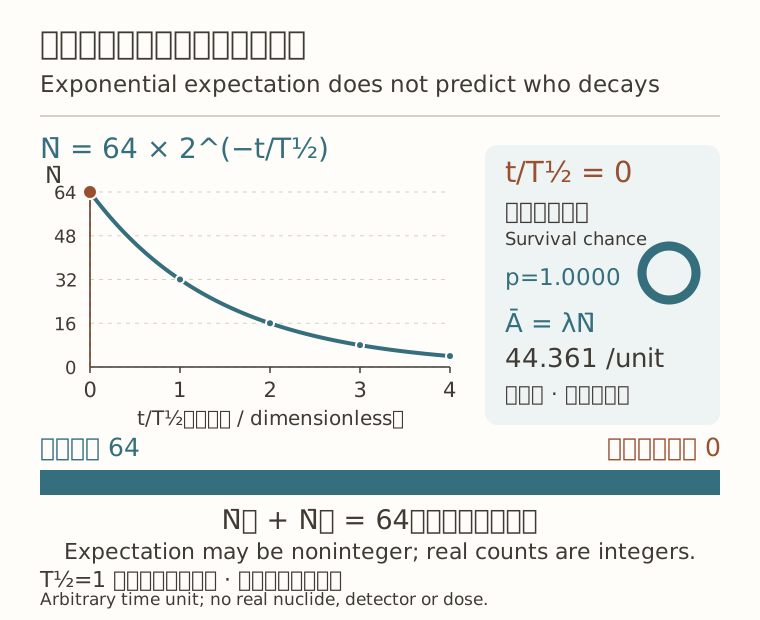
初始条件:64 个母核Initial condition: 64 parents
1 / 5初始设定为 64 个独立假想母核,p=1,期望母核数为 64,期望子核数为 0。每个母核都遵循相同、恒定的衰变概率率;这里没有列出它们各自将在何时衰变。平均活度 Ā=λN̄≈44.361 每任意时间单位,既不是某个时间窗中的实测计数,也不赋予真实剂量。
Start with 64 independent hypothetical parent nuclei: p=1, expected parents 64 and expected daughters 0. Each parent has the same constant decay probability per time, without a scheduled decay time. Mean activity Ā=λN̄≈44.361 per arbitrary time unit is neither a measured count in a window nor a real dose.
- 时间 t/T½Time t/T½
- 单核存活概率 pSingle-parent survival probability p
- 期望母核数 N̄Expected parents N̄
- 期望稳定子核数Expected stable daughters
- 期望累积衰变数Expected cumulative decays
- 平均活度 Ā=λN̄Mean activity Ā=λN̄
- 母核数标准差 σ(非置信区间)Parent-count SD σ (not a confidence interval)
模型边界Model boundary
模型边界:N₀=64 个相互独立、同种假想母核;T½=1 任意教学时间单位,不对应真实核素或剂量。无量纲时间为 t/T½,λ=ln2/T½=ln2 每任意单位,p=2^(−t/T½)。N̄=N₀p 是实数期望,不保证每次恰有一半衰变;实际母核数 K∼Binomial(N₀,p),σ=√[N₀p(1−p)] 是标准差,不是置信区间。Ā=λN̄ 是平均衰变率,不是探测计数。假定每次母核衰变产生一个稳定子核,所以期望母核数加期望子核数恒为64,记录母核谱系而非全部产物的核数或质量;能量可随粒子或辐射释放,本页无能量数值读数。忽略衰变链、探测效率、背景和具体电子环境,显示值才作四舍五入。[5,6]
Model boundary: N₀=64 independent hypothetical parents of one kind. T½=1 arbitrary teaching time unit refers to no real nuclide or dose. Dimensionless time is t/T½, λ=ln2/T½=ln2 per arbitrary unit, and p=2^(−t/T½). N̄=N₀p is a real-valued expectation, not a guarantee that exactly half decay. Actual parent count K∼Binomial(N₀,p); σ=√[N₀p(1−p)] is SD, not a confidence interval. Ā=λN̄ is a mean decay rate, not a detector count. Each decayed parent is assumed to produce one stable daughter, so expected parents plus expected daughters stay at 64, accounting for parent lineages rather than the number or mass of all products. Energy may leave in particles or radiation; no numerical energy reading is given. Decay chains, detection efficiency, background and specific electronic environments are omitted. Only displayed values are rounded.[5,6]
半衰期不是单个原子的倒计时
A half-life is not an individual atom's countdown
现代简化模型假设母核独立衰变,足够短的Δt内,衰变概率约为λΔt。它不指定某个核何时转变,而给出时间t后的存活概率p=e^(−λt)。半衰期T₁/₂对应p=1/2,故λ=ln2/T₁/₂。[5]
A simplified modern model assumes independent parent-nucleus decays, with decay probability approximately λΔt over a sufficiently short interval Δt. It does not specify when an individual nucleus transforms; its survival probability after time t is p = e^(−λt). At half-life T₁/₂, p = 1/2, giving λ = ln 2/T₁/₂. [5]
下方例子从64个假想母核开始,把半衰期设为一个任意时间单位。它不代表铀、镭或其他真实核素,也没有剂量含义。每过一个半衰期,每个存活母核再有一半机会继续存活,并非排队等待统一响起的闹钟。[5]
The teaching example below begins with 64 hypothetical parent nuclei and sets the half-life to one arbitrary time unit. It represents no actual nuclide and carries no dose meaning. During each half-life, every surviving parent has another one-half chance of surviving; there is no shared alarm clock determining individual events. [5]
由N₀p计算,零到四个半衰期的预期剩余数为64、32、16、8、4;预期累计衰变数为0、32、48、56、60。这是许多次同类实验的平均趋势,单次样本不必恰好对半减少,图标也不能冒充测量记录。[5]
Calculating N₀p gives expected survivors of 64, 32, 16, 8 and 4 at zero through four half-lives, with expected cumulative decays of 0, 32, 48, 56 and 60. These describe averages over many repetitions. An individual sample need not halve exactly, and icons are not measurement records. [5]
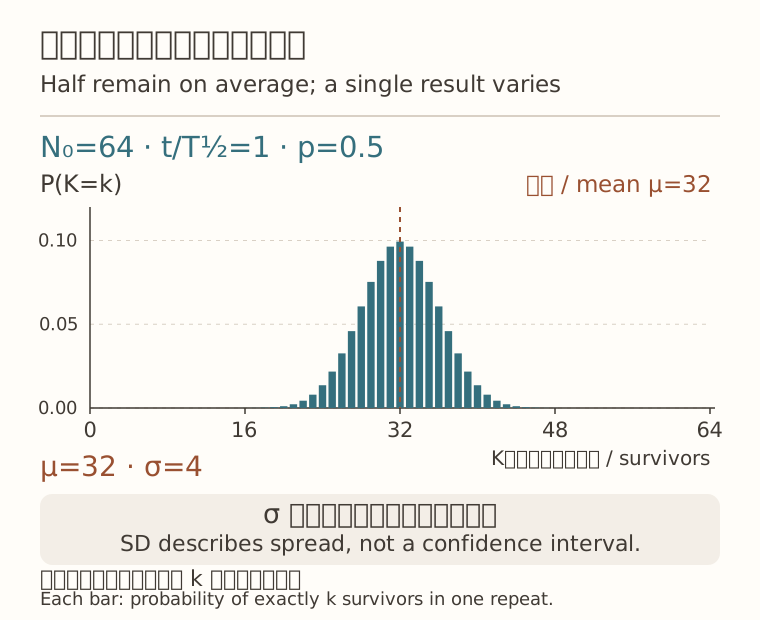
从独立存活假设可推得,固定时刻的剩余数服从二项分布,方差为N₀p(1−p)。第一个半衰期均值32、标准差4;这个宽度描述随机波动,并非确定上下限。母核减少时,少量事件造成的相对起伏更显眼。
The independent-survival assumption further gives a binomial distribution of survivors at a fixed time, with variance N₀p(1 − p). At one half-life, the mean is 32 and the standard deviation 4. This width describes random variation, not guaranteed bounds. As parents become fewer, small event-number variations become more conspicuous relative to the mean.
读懂计数,也读懂能量
Reading the counts and the energy correctly
预期活度为λ乘以预期剩余母核数,表示单位时间的预期衰变数。它不等于探测器实际计数率:探测效率、几何条件与本底都会介入。本例未模拟这些因素,不能把曲线数值直接当作仪器读数。[5]
Expected activity is λ times the expected number of remaining parents: expected decays per unit time. It differs from an instrument's recorded count rate, which also depends on efficiency, geometry and background. Those factors are absent from this example, so curve values cannot be treated as predicted instrument readings. [5]
母核减少不是整份物质消失。本例每个母核转变后留下一个稳定子核;真实衰变可能有后续链条。释放能量来自初末状态的质量能差,并非无中生有;若每次释放相同能量,平均释放功率才与活度成正比,不与单次随机计数同步。[5]
Fewer parents do not mean that the material vanishes. This example assumes one stable daughter per parent; actual decays can lead to further chains. Released energy comes from the initial-to-final mass-energy difference. With the same energy released per decay, mean release power is proportional to activity, rather than following every random recorded count. [5]
居里的关键线索,是让化学分离与可重复测量互相检验,从异常活性追到元素身份。现代核与概率模型继续解释:宏观样品呈现稳定规律,单个事件仍有随机性。承认这两层事实,才能理解半衰期,不把模型的整齐误当成逐次记录。[2,5]
Curie's crucial contribution connected chemical separation with repeatable measurement, following anomalous activity towards elemental identity. Modern nuclear and probability models extend the explanation: macroscopic samples show regular trends while individual events remain random. Recognising both levels makes half-life intelligible without mistaking an orderly model for nature's event-by-event record. [2,5]
参考资料 / References
- NobelPrize.org · Marie Curie — Facts · Nobel Prize in Physics 1903诺贝尔官方事实页:1896年贝克勒尔发现放射性;玛丽与皮埃尔继续研究;1903年物理学奖及1911年化学奖。1903年三人共享、1911年玛丽单独获奖另以诺贝尔两届奖项概要交叉核验,具体链接列于来源审计。
- Marie Curie · Radium and the New Concepts in Chemistry · Nobel Lecture, 11 December 1911居里本人的回顾性原始讲演:空气电离与电流测量、铀与钍活性随元素量变化、化学态比较、矿石异常活性、化学分离后测量、纯镭盐与原子量证据。历史的原子性质假说与本文现代核模型分开叙述。
- P. Curie & M. Curie · Sur une substance nouvelle radio-active, contenue dans la pechblende · Comptes rendus 127, 175–178 (18 July 1898)法国科学院托管钋论文原始扫描:矿石异常活性、铀与钍的元素性质、分离与测量、随铋组分富集、钋命名及存在有待确认的限定。日期与正文以1908年《Œuvres de Pierre Curie》重印转录交叉核验;不把初次报告写成当日已制得纯钋。
- P. Curie, M. Curie & G. Bémont · Sur une nouvelle substance fortement radio-active contenue dans la pechblende · Comptes rendus 127, 1215–1217 (26 December 1898)法国科学院托管镭论文原始扫描:三人署名、与钡相近的化学行为、异常放射性及光谱证据、镭的命名。原文的物质主要仍为钡组分,不宣称1898年已完成纯金属镭的分离。
- OpenStax · University Physics Volume 3 · Chapter 10 Nuclear Physics, §§10.1–10.3第10.1节支持核素与电子主导化学性质的区别;第10.2节Nuclear Binding Energy支持质量能差与能量释放;第10.3节Radioactive Decay支持现代衰变、指数律、半衰期与λ的关系及活度。64母核、任意半衰期单位及五组数值由本文计算;二项分布和方差由独立存活假设推导,不冒称第10.3节给出了完整概率质量函数。普通环境近似不变的表述以[6]限定。
- T. Ohtsuki, K. Ohno, T. Morisato & K. Hirose · Lifetime Measurement of ⁷Be in Beryllium Metal Crystal · Materials Transactions 48, 646–648 (2007)原始实验论文与出版社全文:电子俘获衰变率涉及核处电子密度,宿主环境可造成小的变化。只用于排除“任何环境绝不影响任何核衰变”的绝对论;正文不使用其真实核素半衰期数值作教学单位,也不把例外扩大成通用化学控制方法。